
March 12, 2026 by: Rev. Mac
In the long arc of technological progress, convenience has often arrived wrapped in promises of security. Each generation is told the same reassuring narrative: the next system will make life easier, safer, and more efficient. Yet occasionally a policy appears that causes people to pause and ask a deeper question.
Not simply “Is this convenient?” but “What kind of world are we building?”
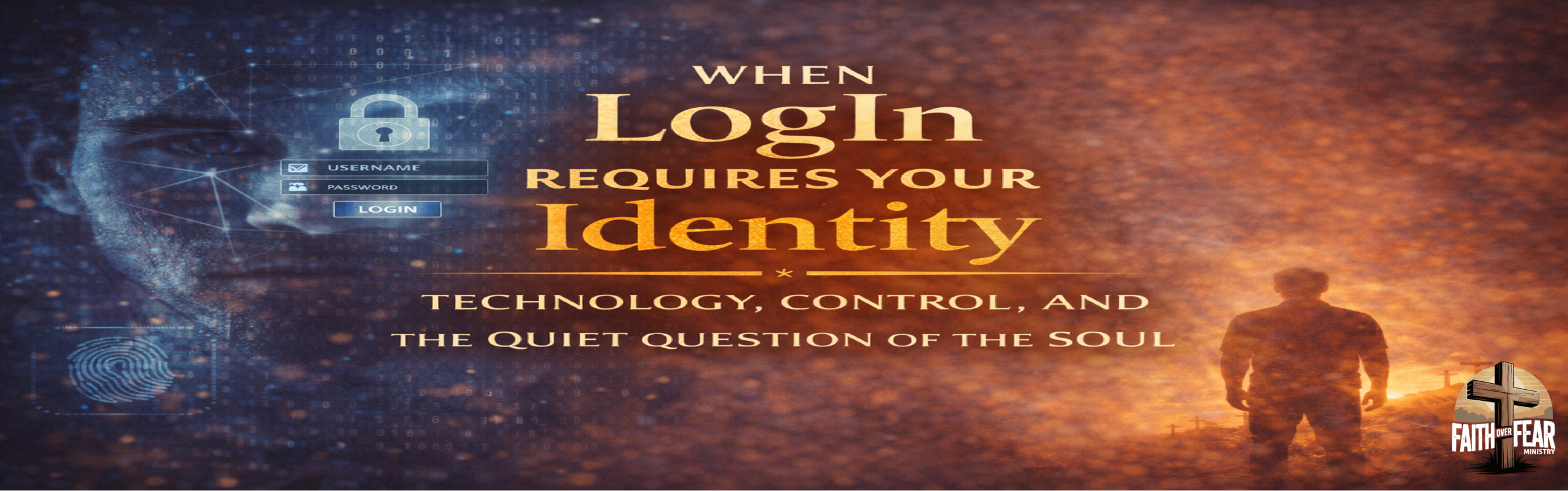
A recently passed law in one U.S. state has stirred exactly that kind of reflection. Under this policy, individuals must verify their identity in order to use certain computer operating systems or online services. In practice, this means linking a personal identity credential, such as government-issued identification, to the ability to access digital tools that many people use daily for work, communication, banking, education, and basic life administration.
Supporters of the law argue that it helps prevent cybercrime, protects children online, and increases accountability in digital environments. Critics, however, see something else emerging beneath the surface.
They see a turning point.
The Expanding Architecture of Control
Modern life is increasingly mediated through digital systems. To participate fully in society today, individuals rely on devices and networks that store nearly every detail of daily existence: communications, finances, purchases, locations, beliefs, and relationships.
The more systems that require identity verification, the more centralized the flow of personal information becomes.
Step by step, a digital architecture begins to form.
First comes the requirement to verify identity for services.
Then the integration of identity across platforms.
Then the aggregation of behavioral data.
Then the ability to monitor patterns.
Eventually, systems designed to “verify” can also begin to evaluate.
When access to digital life becomes conditional upon identity, the infrastructure quietly emerges for something else entirely: the ability to grant or deny participation.
This possibility is what many observers find troubling.
The concern is not merely about technology. It is about power.
History repeatedly demonstrates that systems built for protection can become tools of control when placed in the wrong hands. When identity, finance, communication, and access all converge within centralized digital frameworks, the potential exists for unprecedented oversight of individual lives.
To some, this resembles the early blueprint of a social credit structure.
The Slippery Path Toward Conditional Freedom
Around the world, governments and institutions are experimenting with systems that link identity to behavior, reputation, and access.
Digital ID systems.
Reputation scoring algorithms.
Programmable digital currencies.
Biometric authentication.
Individually, each initiative may appear practical. Together, they form a framework capable of determining not just who you are, but what you are allowed to do.
Imagine a future where financial transactions, travel, employment, and communication require continuous identity verification tied to behavioral compliance.
Imagine a system where dissent, unpopular speech, or deviation from approved norms could affect one’s ability to access services.
Imagine a world where participation itself becomes conditional.
For many observers, the trajectory of these developments raises an unsettling question: Are we gradually constructing the mechanisms of a fully monitored society without fully recognizing it?
Ancient Warnings in a Digital Age
Long before modern technology existed, the Bible spoke of a future system in which economic participation would be tied to allegiance and identification.
In the Book of Revelation, Scripture describes a time when individuals would not be able to buy or sell without a particular mark associated with political and spiritual authority.
For centuries, readers interpreted these passages symbolically. But in an age where identity verification, digital currency, and centralized control are technically possible on a global scale, many believers now view these warnings through a new lens.
The concern is not that a single law immediately fulfills prophecy. Rather, it is that society may be moving incrementally toward systems capable of enabling such conditions.
Technological capability is arriving faster than the moral frameworks needed to govern it.
And when power concentrates without restraint, history reminds us that freedom rarely expands.
The Deeper Question Beneath the Debate
Beyond policy arguments and technological concerns lies a deeper spiritual question.
Where do we place our trust?
For centuries, societies have looked to governments, institutions, and economic systems to provide stability and security. Yet the more complex and centralized these systems become, the more fragile they appear.
The human desire for control often leads to structures that promise order but risk diminishing freedom.
In contrast, the message of the Gospel offers something radically different.
Jesus did not come to build a system of control. He came to offer liberation.
He spoke not of domination but of service.
Not of surveillance but of transformation.
Not of coercion but of redemption.
His kingdom was never meant to mirror the structures of worldly power. Instead, it calls individuals to a life rooted in humility, faith, and love.
Faith in an Age of Systems
Technological change will continue. Laws will evolve. Digital systems will expand.
These developments are unlikely to slow.
But for believers, the ultimate question is not whether the world becomes more complex. It is whether individuals will anchor themselves in something eternal rather than something temporary.
Faith in Christ provides that anchor.
When a person develops a genuine relationship with Jesus, life begins to shift. Purpose replaces anxiety. Service replaces self-interest. Hope replaces fear.
The Christian life is not about escaping the world. It is about living within it with clarity and courage.
A life rooted in faith allows individuals to navigate uncertainty without losing their moral compass.
It teaches that human worth does not come from digital identity, economic participation, or social approval.
It comes from being created in the image of God.
A Call to Reflection
Moments of societal change often invite deeper reflection about what truly matters.
Technological systems may shape the structure of society, but they cannot define the soul.
No law can regulate faith.
No algorithm can measure grace.
No database can capture redemption.
The question facing individuals today is not simply whether new technological requirements are wise or unwise.
The deeper question is whether people will place their trust in systems built by human hands, or in the One who offers eternal life.
For those searching for meaning in uncertain times, the invitation remains open.
Seek the Lord.
Know Christ.
Build a life grounded not in the shifting structures of the world, but in the enduring truth of the Gospel.
Because while systems rise and fall throughout history, the message of Jesus continues to offer something no government, technology, or institution can ever provide.
True freedom.