
May 1, 2026 by: Rev. Mac
There is something quietly funny, and deeply convicting, about Matthew 13.
Jesus is standing before crowds of people, teaching them about the Kingdom of Heaven, and He chooses to do it by talking about seeds, soil, weeds, yeast, treasure, pearls, nets, and fish. On the surface, it sounds almost too simple. Farmers understood seed. Bakers understood yeast. Fishermen understood nets. Merchants understood pearls. Everyone understood the frustration of weeds growing where something valuable had been planted.
And yet, that is exactly the point.
Jesus was not merely teaching cute spiritual lessons. He was revealing eternal truths through ordinary things. He was showing us that the Kingdom of Heaven is not hidden because God is unwilling to reveal it, but because many hearts are unwilling to receive it.
That is what makes Matthew 13 so powerful for us today. We live in a world obsessed with planning, progress, and results. We set goals for our businesses, finances, health, families, homes, and futures. We plant ideas and expect outcomes. We measure success by growth. We do not usually begin something hoping it stays small, weak, unfruitful, or forgotten.
When we plan something, the goal is to see growth. We want to enjoy the results.
The same is true with our faith.
The question is not simply, “Do you believe?” The deeper question is, “Is what you believe growing?”
What Is a Parable?
A parable is a short earthly story with a heavenly meaning. It takes something familiar and uses it to reveal something spiritual. Jesus used parables to teach truth in a way that invited the humble to lean in, while also exposing the hardened hearts of those who only wanted religion without transformation.
In Matthew 13, the disciples ask Jesus why He speaks to the people in parables. His answer is sobering. He explains that some people see but do not truly see, and hear but do not truly hear or understand. In the NLT, Jesus points to the condition of the heart, describing people whose hearts are hardened, whose ears cannot hear, and whose eyes are closed.
That is not just ancient history. That is a mirror.
Many people hear sermons. Many read Scripture. Many attend church. Many say the right things. But Jesus makes it clear that hearing spiritual truth and receiving spiritual truth are not the same thing.
A parable is not just a teaching tool. It is a heart revealer.
Matthew 13 Begins With Soil, Not Seed
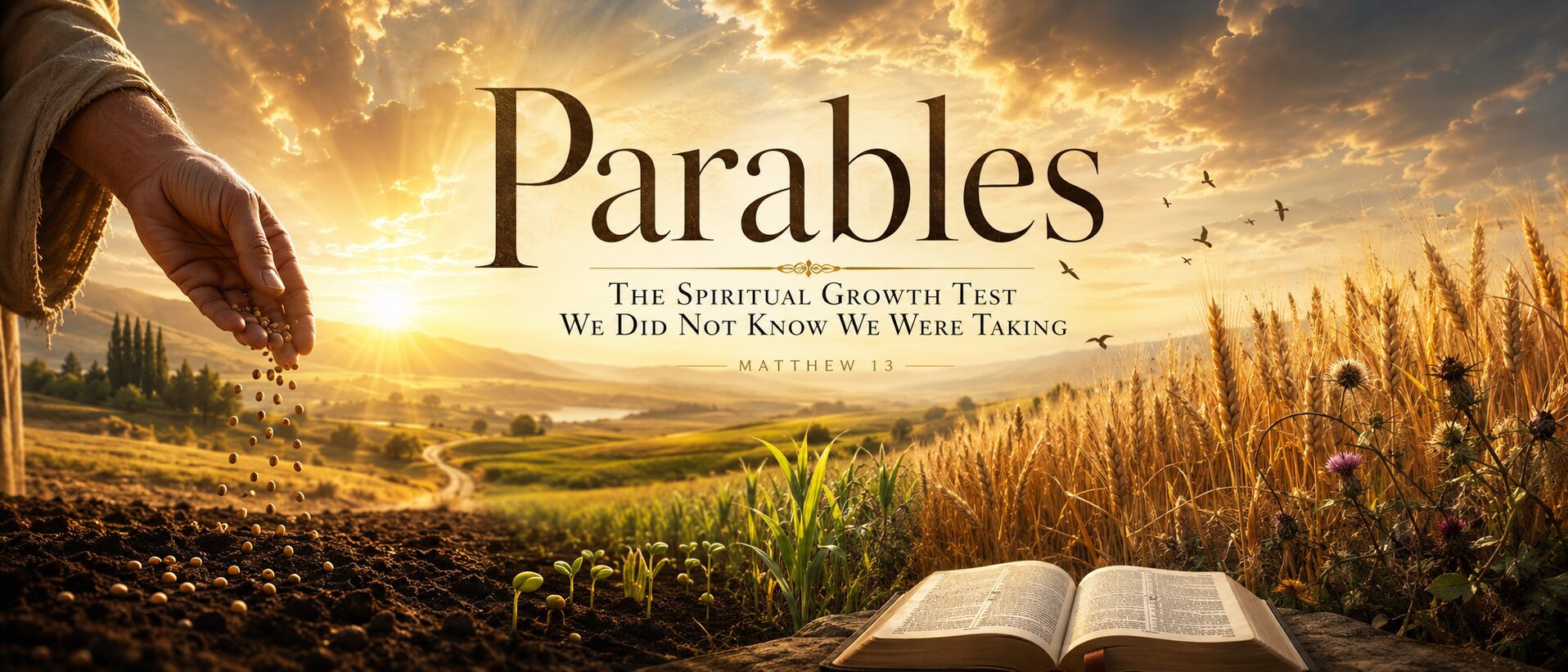
The first major parable in Matthew 13 is the Parable of the Farmer Scattering Seed. Jesus describes seed falling on different types of ground: a footpath, rocky soil, thorny ground, and good soil.
The seed represents the message of the Kingdom. The soil represents the condition of the human heart.
This is important because the seed is not the problem.
The Word of God is not weak. The Kingdom message is not defective. The truth is not powerless. The issue is the soil.
Some people hear the message, but it never penetrates. It stays on the surface, and the enemy comes quickly to snatch it away. Some receive the message with joy, but because they have no deep roots, they fall away when trouble comes. Some hear the Word, but the worries of life and the lure of wealth choke it out. But some hear, understand, receive, and produce a harvest.
That is where the uncomfortable question begins.
What kind of soil are we?
Not what kind of soil do we claim to be. Not what kind of soil do we look like on Sunday morning. Not what kind of soil do others assume we are.
What kind of soil are we when pressure comes?
What kind of soil are we when temptation arrives?
What kind of soil are we when obedience costs us something?
What kind of soil are we when God’s Word challenges our preferences, politics, pride, habits, or comfort?
Jesus is teaching that spiritual growth is not accidental. Fruitfulness depends on the condition of the heart.
The Spiritual Maturity Scale
Let us ask a question that may sound unusual:
On a scale from 1 to 100, what is your spiritual maturity?
Not your church attendance.
Not your Bible app streak.
Not your ability to quote Scripture.
Not your public image.
Not your ministry title.
Not how long you have called yourself a Christian.
Your spiritual maturity.
A person at a 10 may hear truth but rarely apply it. A person at a 25 may believe in God but still allow fear, anger, pride, lust, greed, or bitterness to rule their decisions. A person at a 50 may be growing but still inconsistent, easily distracted, and often spiritually reactive instead of spiritually rooted. A person at a 75 may show real fruit, but still recognizes deeper areas where surrender is needed. A person at a 90 is not perfect, but their life consistently reflects obedience, humility, repentance, love, wisdom, discipline, and dependence on God.
The number itself is not the point. The honesty is.
Because faith is not supposed to remain a seed packet sitting on the shelf. Faith is supposed to be planted, watered, tested, rooted, and fruitful.
We Do Not Just Learn Spiritually. We Apply Spiritually.
One of the great dangers of modern Christianity is that many people confuse exposure with transformation.
We hear sermons and think we have grown.
We read devotionals and think we have matured.
We repost Christian quotes and think we have witnessed.
We attend church and think we have obeyed.
But learning is not the finish line.
Application is where spiritual maturity begins to show.
Jesus did not teach parables so people could admire His storytelling ability. He taught them so people would respond. The Parable of the Sower is not merely about understanding four types of soil. It is about asking God to break up the hardened places in us, deepen the shallow places, remove the thorns, and make us fruitful.
That means we must ask harder questions.
Do I forgive, or do I only know that forgiveness is biblical?
Do I serve, or do I only agree that serving is good?
Do I trust God, or do I only say I trust Him when life is comfortable?
Do I repent, or do I simply feel bad when I am confronted?
Do I obey Scripture, or do I edit Scripture to protect my lifestyle?
Spiritual knowledge without spiritual application can become religious decoration. It looks good from a distance, but it does not produce fruit.
Jesus is after fruit.
The Weeds Among the Wheat
Matthew 13 also includes the Parable of the Wheat and the Weeds. Jesus describes a farmer who plants good seed, but an enemy comes at night and plants weeds among the wheat. When both begin to grow, the servants ask whether they should pull up the weeds. The farmer tells them to wait until harvest, because pulling up the weeds too early could damage the wheat.
This parable reminds us that not everything growing in the field belongs to God.
That is a hard truth.
There are things in the world, in culture, in institutions, in churches, and even in our own hearts that may appear to be growing alongside what is good. But growth alone does not prove righteousness. Influence alone does not prove truth. Popularity alone does not prove God’s blessing.
Some things grow because they are planted by God. Other things grow because the enemy is trying to counterfeit, choke, confuse, or corrupt what God has planted.
That is why discernment matters.
The Christian life is not only about growth. It is about godly growth.
The Mustard Seed and the Yeast
Jesus then compares the Kingdom of Heaven to a mustard seed, which begins small but grows into something much larger. He also compares the Kingdom to yeast worked through dough until it spreads throughout.
These parables are encouraging because they remind us that God often begins with what looks small.
A prayer.
A conviction.
A moment of repentance.
A Scripture that will not leave your mind.
A small act of obedience.
A quiet decision to surrender.
A conversation.
A calling.
A seed.
We often underestimate small beginnings because we are addicted to visible results. But the Kingdom does not always announce itself with noise. Sometimes it works beneath the surface. Sometimes it grows slowly. Sometimes it begins in hidden places before it becomes visible.
The question is whether we are willing to keep tending what God has planted.
Faith grows through obedience, not performance. It grows through surrender, not spiritual theater. It grows when the Word of God moves from information to formation.
The Hidden Treasure and the Pearl
In Matthew 13, Jesus also tells of a man who discovers hidden treasure in a field and joyfully sells everything he owns to buy that field. He then speaks of a merchant who finds a pearl of great value and sells everything to obtain it.
These parables confront our priorities.
When someone truly sees the value of the Kingdom, sacrifice no longer feels like loss. It becomes joy.
That is difficult for a culture trained to chase comfort, status, entertainment, money, and approval. We often want Jesus as an addition to our lives, not the treasure over our lives. We want enough faith to feel safe, but not so much surrender that we have to change.
But Jesus does not present the Kingdom as a hobby. He presents it as treasure.
The person who understands its worth does not ask, “How little can I give and still be saved?” They ask, “What could possibly compare to this?”
The Net and the Final Sorting
Near the end of the chapter, Jesus compares the Kingdom to a fishing net thrown into the water. It gathers all kinds of fish, but eventually the good are separated from the bad.
This is not a soft parable. It is a warning.
There will be a final sorting. There will be a day when appearances are stripped away. There will be a day when spiritual claims are measured against spiritual reality.
That should not make believers live in fear, but it should make us live awake.
Matthew 13 calls us to examine our hearts before harvest day. It invites us to ask whether our faith is producing fruit or merely occupying space.
Why Matthew 13 Is Funny From This Point Today
Here is the funny part, though it is the kind of funny that makes you stare out a window afterward.
Jesus used simple stories because the truth was not complicated. Seeds grow in good soil. Weeds compete with wheat. Yeast spreads through dough. Treasure changes priorities. Nets eventually get sorted.
None of this is hard to understand.
And yet we still complicate it.
We build systems around faith, arguments around faith, aesthetics around faith, platforms around faith, and identities around faith. We study the seed, analyze the weather, debate farming methods, and admire other people’s harvests.
But Jesus keeps bringing us back to the soil.
Is your heart receiving the Word?
Is your faith growing roots?
Are the worries of life choking your obedience?
Are you producing fruit?
Do you value the Kingdom more than everything else?
Are you applying what you have learned?
That is what makes Matthew 13 so piercing. Jesus teaches with everyday images, but those images leave us spiritually exposed.
The farmer planted.
The seed was good.
The question is the soil.
Conclusion: Dead Faith Does Not Grow
Planning something with no desire for growth would be strange. No farmer plants seed hoping nothing happens. No builder lays a foundation hoping the structure never rises. No business owner creates a plan hoping it produces nothing. No parent teaches a child hoping wisdom never takes root.
So why would we treat faith differently?
If we say we follow Christ, there should be growth. Not perfection. Not performance. Not religious pride. Growth.
There should be deeper roots, fewer thorns, greater obedience, stronger discernment, richer humility, quicker repentance, and more visible fruit. There should be evidence that the Word of God is not merely being heard but received, not merely learned but lived.
Matthew 13 is not just a chapter about parables. It is a spiritual diagnostic. It asks us to look honestly at the field of our lives and decide whether we are growing what God planted or protecting what is choking it.
So here is the question:
On a scale from 1 to 100, where is your spiritual maturity today?
And perhaps the better question is this:
What are you going to do with the seed God has already given you?