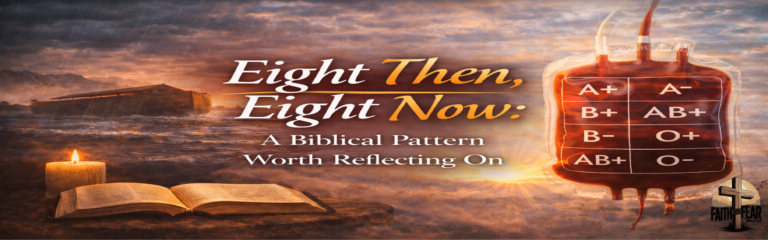
The Bible often communicates through patterns, numbers, repetition, and symbolism woven quietly into the story of redemption. Some patterns are explicit, others subtle enough to invite reflection rather than declaration. One such pattern emerges when considering the story of Noah and a striking reality of modern biology.
According to Scripture, only eight people were preserved aboard Noah’s ark during the global flood: Noah, his wife, his three sons, and their wives (Genesis 7–9). These eight became the starting point for humanity after judgment and renewal.
Faith does not grow by accident. It is formed through intention, obedience, and daily choices that align the heart with God’s truth. Many profess faith in Christ, yet quietly struggle with inconsistency, distraction, and spiritual fatigue. Scripture makes clear that faith is not only something we believe, but it is something we live.
For followers of Christ who desire a deeper, stronger walk with God, three priorities rise to the surface again and again throughout Scripture: discipline, priorities, and self-control. Together, they form the framework of a faith that endures pressure, resists temptation, and produces lasting transformation.
Trauma leaves marks that time alone does not erase. For many, the echoes of past pain linger as anxiety, hyper-vigilance, intrusive memories, or emotional numbness experiences often described under the broad category of post-traumatic stress. These struggles are not signs of weakness. They are evidence that the human mind and soul remember what the heart has endured.
In a world that increasingly turns to medication, self-optimization, or distraction as primary solutions, Scripture offers a different starting point; not as a replacement for care, but as a foundation for healing that reaches deeper than symptom management.
The Bible speaks not only to behavior, but to wounds. And for countless believers, a growing relationship with Jesus Christ has become the place where real restoration begins.
Habakkuk’s short book carries a long echo. Across three chapters, the prophet walks a path many modern believers recognize: outrage at injustice, confusion over God’s methods, and finally, a faith that endures even when circumstances remain unresolved.
What makes Habakkuk timeless is not the specificity of his era, but the universality of his posture. His journey mirrors our own world; marked by political instability, the rise and fall of powers, and communities straining under the weight of uncertainty.
Habakkuk’s final chapter does not begin with resolution. There is no sudden political reform, no collapse of empires, no immediate justice restored. What changes instead is the prophet himself.
Habakkuk chapter 3 opens not as a continuation of complaint or debate, but as a prayer set to music. “This prayer was sung by the prophet Habakkuk” (Habakkuk 3:1, NLT). The shift is striking. Where there were questions, there is now worship. Where there was protest, there is remembrance.
Habakkuk teaches us that faith does not always require circumstances to change before worship begins.
If Habakkuk chapter 1 gives voice to frustration, chapter 2 teaches posture.
After questioning God about injustice, corruption, and the rise of violent powers, the prophet does something quietly radical: he waits. “I will climb up to my watchtower and stand at my guard post,” Habakkuk declares. “There I will wait to see what the Lord says” (Habakkuk 2:1, NLT).
In an age defined by immediacy; instant reactions, real-time outrage, and endless commentary, Habakkuk’s decision to stand watch feels almost subversive. He does not rush to conclusions or broadcast assumptions. He chooses attentiveness.
The opening chapter of Habakkuk reads less like ancient prophecy and more like a contemporary op-ed. It begins not with instruction, but with frustration. Not with answers, but with questions.
“How long, O Lord, must I call for help?” the prophet asks. “But you do not listen!” (Habakkuk 1:2, NLT).
This is not a whisper of doubt. It is a public lament. And for modern readers navigating political unrest, global instability, and fractured communities, Habakkuk’s cry feels uncomfortably familiar.
January 6, 2026 by: Rev. Mac Every January arrives with fresh calendars and recycled promises. We vow to be healthier, wealthier, more productive, and more disciplined. But as…