
May 28, 2026 by: Rev. Mac
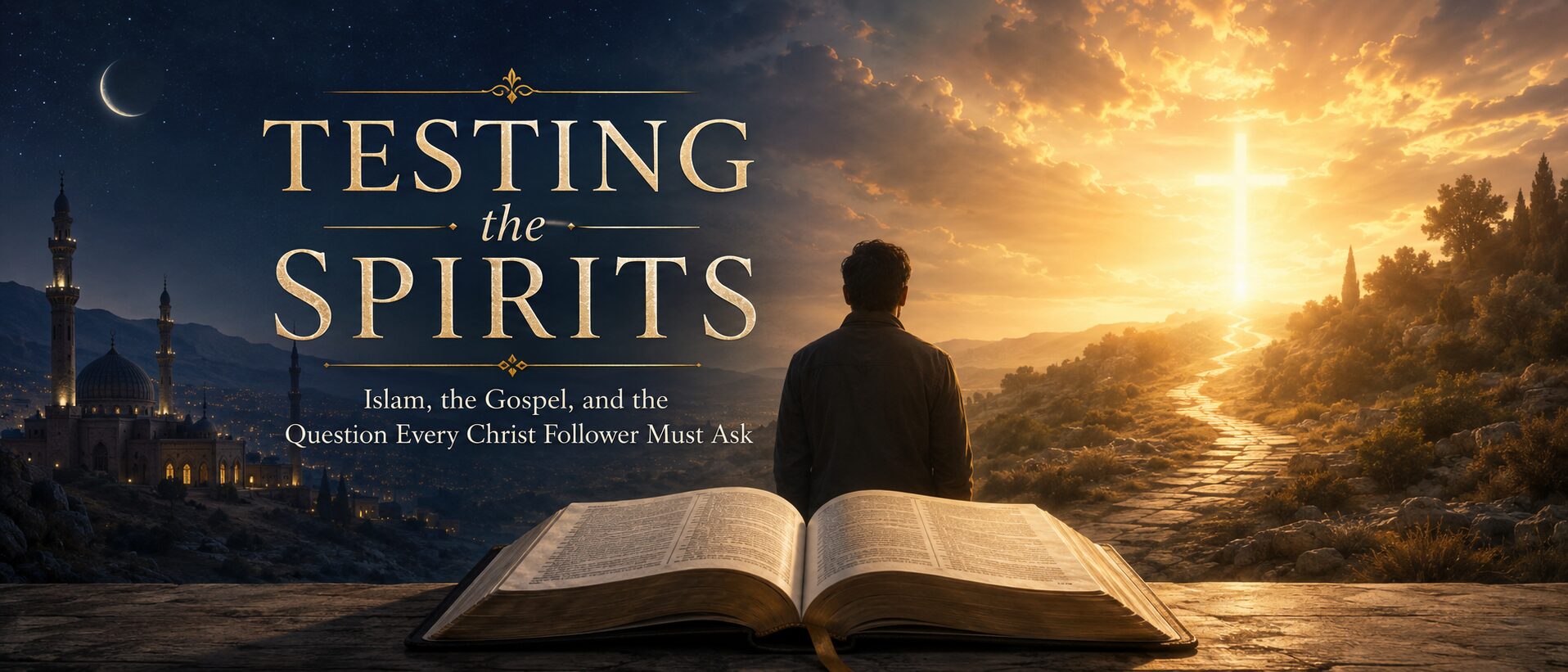
There are some questions Christians cannot afford to answer lazily.
In a world where every religion is often treated as merely a different road up the same mountain, the follower of Jesus must be willing to ask a harder question: What happens when a religious system speaks often of God, morality, prayer, judgment, and eternity, yet denies the very identity and saving work of Jesus Christ?
That question is not about hatred. It is about truth.
Christianity does not call believers to despise Muslims. Every Muslim man, woman, and child is made in the image of God and is someone Jesus died to save. The Gospel gives no permission for cruelty, mockery, racism, revenge, or fear-driven hostility. Jesus commands His followers to love their neighbors, pray for their enemies, and proclaim the truth with grace.
But love does not require silence.
If Jesus is truly the King of kings and Lord of lords, then every spiritual claim must be brought before Him. Every prophet must be tested. Every doctrine must be examined. Every religious system must be measured against the Gospel.
The issue is not whether Christians can be kind to Muslims. We must be.
The issue is whether Islam’s claims about God, Jesus, sin, salvation, law, and human nature can stand beside the Gospel of Jesus Christ.
From a Christian perspective, the answer is no.
The Battle Is Not Against People
Before any serious Christian critique begins, Ephesians 6:12 must be allowed to speak. The Bible teaches that our battle is not against flesh-and-blood people, but against spiritual powers and authorities in the unseen world. That means the Christian does not look at a Muslim neighbor and see an enemy. The Christian sees a soul worth loving, a person worth listening to, and someone who needs the same grace we ourselves have received.
This distinction matters.
When Christians critique Islam, they must avoid turning human beings into targets. The Gospel does not send us into the world with clenched fists. It sends us with open hands, clear eyes, and a cross-shaped love that refuses to lie.
The question is not, “How can we attack Muslims?”
The question is, “How can we faithfully discern spiritual truth from spiritual deception?”
The New Testament tells believers to test the spirits to see whether they come from God. In 1 John 4:1-3, the test centers on Jesus Christ. Any spirit that refuses the true confession of Christ is not from God. Galatians 1:8-9 also warns against accepting another gospel, even if it were preached by an angelic messenger.
That warning should make every Christian pause.
Islam claims Muhammad received revelation through the angel Gabriel, and those revelations became the foundation of the Qur’an. Islamic tradition holds that Muhammad began receiving these revelations around age forty, and that they formed the Qur’an over time.
Christianity must ask: does that revelation agree with the apostolic Gospel?
It does not.
The Central Divide: Who Is Jesus?
At the center of Christianity stands Jesus Christ: crucified, risen, divine, Lord, Savior, Son of God, and the only way to the Father.
In John 14:6, Jesus says He is the way, the truth, and the life, and that no one comes to the Father except through Him. In Acts 4:12, the apostles proclaim that salvation is found in no one else. In Colossians 1:15-20, Christ is presented as supreme over all creation, the One through whom God reconciles everything to Himself by the blood of the cross.
Islam honors Jesus in certain ways, but it denies the most essential Christian claims about Him. Islam does not confess Jesus as God the Son. It does not proclaim His death on the cross as the once-for-all atoning sacrifice for sin. It does not worship Him as risen Lord.
That is not a small disagreement.
That is the dividing line between the Gospel and another message.
A religion can speak respectfully about Jesus and still reject who He truly is. Compliments are not confession. Religious admiration is not saving faith. A Jesus reduced to prophet, teacher, or moral example is not the Jesus of the New Testament.
The Gospel does not present Christ as one prophet among many.
It presents Him as Lord of all.
Grace Versus Religious Control
The Gospel announces grace.
Ephesians 2:8-9 teaches that salvation is not earned by human effort, but received as a gift through faith. Romans 5 declares that Christ died for us while we were still sinners. Titus 3:5 says God saved us not because of righteous things we had done, but because of His mercy.
This is the thunderclap of Christianity: God does not wait for sinners to climb high enough to reach Him. He comes down in Christ to rescue them.
That is radically different from any system where human standing before God is ultimately weighed by religious performance, submission to law, ritual compliance, or fear of punishment.
The Christian does not obey in order to purchase salvation.
The Christian obeys because salvation has already been purchased by Christ.
That difference is not theological decoration. It is the difference between a prison door and an empty tomb.
The Qur’an, Violence, and the Need for Honest Reading
Some Christians point to violent passages in the Qur’an and argue that Islam promotes hostility toward unbelievers. Muslims often respond that those passages have historical context, that the Qur’an also contains verses against compulsion, and that violent readings are misused by extremists.
Both facts must be acknowledged honestly.
The Qur’an includes passages often cited in debates about violence, including Surah 9:5 and 9:29. Quran.com’s own explanatory material presents Surah 9:5 as connected to conflict with hostile treaty-breakers rather than a blanket command to kill all non-Muslims. At the same time, Surah 9:29 contains language about fighting certain “People of the Scripture” until they pay jizya in a humbled condition, which raises serious questions for Christians and other non-Muslims about religious coercion and second-class status.
The point is not to flatten all Muslims into one violent stereotype. Many Muslims are peaceful, generous, hospitable, and morally serious people. Many reject terrorism and coercion.
But the Christian apologist must also be honest: Islamic scripture and legal tradition contain categories of religious rule, submission, and political authority that differ sharply from the New Testament model of witness, persuasion, suffering love, and voluntary faith.
Jesus did not send His disciples with swords to force conversion.
He sent them with the Gospel.
Sharia and the Ten Commandments
Sharia is often misunderstood in Western conversations. It is not merely a criminal code, nor is it identical in every Muslim-majority country. In Islamic legal theory, sharia draws from the Qur’an and the Sunnah, which refers to Muhammad’s sayings and conduct. Traditional Islamic jurisprudence also recognizes other sources such as scholarly consensus and analogical reasoning.
That said, sharia is not simply the Islamic version of the Ten Commandments.
The Ten Commandments, given in Exodus 20 and Deuteronomy 5, function in biblical history as covenant commands given to Israel after God rescued His people from slavery. They begin not with human achievement, but with divine deliverance. BibleProject summarizes the Ten Commandments as core instructions given to a rescued people in covenant relationship with God.
In Christian understanding, the law reveals God’s holiness, exposes sin, and points us to our need for grace. Romans 3 teaches that the law shows us our sin; Galatians 3 presents the law as a guardian until Christ came; and Romans 8 declares that what the law could not do because of human weakness, God did through His Son.
Sharia, by contrast, is a comprehensive religious-legal framework that can govern worship, family life, finance, public morality, inheritance, criminal penalties, and political order, depending on interpretation and implementation.
The difference is enormous.
The Ten Commandments reveal the moral holiness of God and point sinners toward their need for redemption.
The Gospel fulfills what the law exposed.
Sharia seeks to order life under Islamic submission.
The Gospel calls people into new life through Christ, then transforms them from the inside out by the Holy Spirit.
One centers on law as religious governance.
The other centers on Christ as crucified and risen Savior.
The Pattern of Spiritual Deception
Christians must be careful when using language about the devil. Scripture does teach that Satan is the father of lies, as Jesus says in John 8:44. It also teaches that the enemy disguises himself as an angel of light, as Paul warns in 2 Corinthians 11:14.
So it is biblically appropriate to ask whether any message that denies the deity, cross, resurrection, and lordship of Jesus reflects spiritual deception.
But Christians should not use that concern as a club against people.
The devil’s strategy has always been deception before destruction. In Genesis 3, the serpent does not begin by denying God exists. He begins by twisting God’s Word. He questions God’s command. He paints obedience as oppression. He offers an alternative path to wisdom.
That is still the pattern of deception.
A false gospel does not always look evil at first glance. It may look moral. It may look disciplined. It may look reverent. It may speak of prayer, fasting, modesty, family, judgment, and obedience. But if it moves people away from the true Christ, then it is spiritually dangerous no matter how religious it appears.
This is why the Christian must not evaluate religion merely by seriousness, discipline, or cultural strength.
The test is Christ.
Does it confess Him as Lord?
Does it proclaim His cross as sufficient?
Does it honor His resurrection as victory?
Does it invite sinners into grace?
Does it produce the fruit of the Spirit?
The Fruit Question
Jesus taught in Matthew 7 that a tree is recognized by its fruit. That principle applies first to individuals, but it also helps us think carefully about systems of belief.
What does a worldview produce when it gains power?
Does it protect conscience or punish dissent?
Does it invite persuasion or rely on coercion?
Does it honor women and men equally as image-bearers before God?
Does it allow people to leave without threat?
Does it produce humility, mercy, forgiveness, truth, and love?
Christians must also be humble enough to apply those questions to themselves. History contains many examples of people using Christian language while betraying the way of Christ. The answer to bad religion is not tribal pride. The answer is repentance and return to Jesus.
Still, the New Testament gives a clear picture of Christian witness. The apostles preach, reason, plead, suffer, forgive, and endure persecution. They do not build the Kingdom by force. The Church is not advanced by domination, but by Spirit-empowered proclamation and sacrificial love.
The cross is not coercion.
The cross is love bleeding for enemies.
Why This Matters Now
This discussion is not merely academic. Many people today are spiritually confused. They are told that truth is arrogant, discernment is hateful, and all religious paths lead to the same destination.
But Jesus did not leave that option open.
He did not say He was one helpful road among many.
He said He is the way.
That claim is either true or false. If it is false, Christianity collapses. If it is true, then every person must respond to Christ.
The Christian response to Islam should therefore be neither fear nor flattery. It should be truth with tears. Conviction without cruelty. Courage without hatred. Discernment without dehumanization.
We can say clearly that Islam denies the Gospel.
We can say clearly that any system denying Christ’s identity and finished work cannot lead people to salvation.
We can say clearly that religious law cannot do what only Jesus can do.
And we can say all of this while loving Muslims enough to share Christ with them.
The True King
Revelation 19 presents Jesus as King of kings and Lord of lords. Philippians 2 says every knee will one day bow and every tongue confess that Jesus Christ is Lord. Colossians 1 declares that all things were created through Him and for Him.
That is the Christian confession.
Not Muhammad.
Not any later prophet.
Not any religious empire.
Not any system of law.
Jesus Christ alone.
The Gospel is not merely that Jesus teaches truth. He is truth. The Gospel is not merely that Jesus points to a path. He is the path. The Gospel is not merely that Jesus offers moral guidance. He offers resurrection life.
Islam may speak of submission, but the Gospel speaks of surrender to the Savior who first surrendered Himself for us.
Islam may speak of law, but the Gospel speaks of grace that fulfills what law could never heal.
Islam may speak of judgment, but the Gospel speaks of mercy triumphing at the cross for all who repent and believe.
Conclusion: Seek Truth, Not Comfort
The goal of this article is not to create hatred. It is to awaken discernment.
If you are a Christian, do not be careless with doctrine. Test every spirit. Know the Word. Understand the Gospel. Love Muslims as neighbors, but do not pretend Islam and Christianity teach the same truth about Jesus.
They do not.
If you are a Muslim reading this, the invitation is not to an argument for argument’s sake. The invitation is to Christ Himself. Read the Gospel. Ask who Jesus truly is. Look at the cross. Look at the empty tomb. Ask whether salvation can be earned by submission to law, or whether it must be received by grace from the Savior.
And if you are someone caught between religions, ideologies, and voices, hear the words of Jesus in Matthew 11:28. He invites the weary and burdened to come to Him for rest.
Not to a system.
Not to fear.
Not to endless striving.
To Him.
The question beneath every religious question is finally this:
Who is Jesus?
Everything depends on the answer.