
July 11, 2026 by: Rev. Mac
Why Non-Catholic Believers Should Pay Attention
When many Protestant and Evangelical Christians hear the words “papal encyclical,” their first instinct may be to dismiss it as something intended only for Catholics.
That would be a mistake.
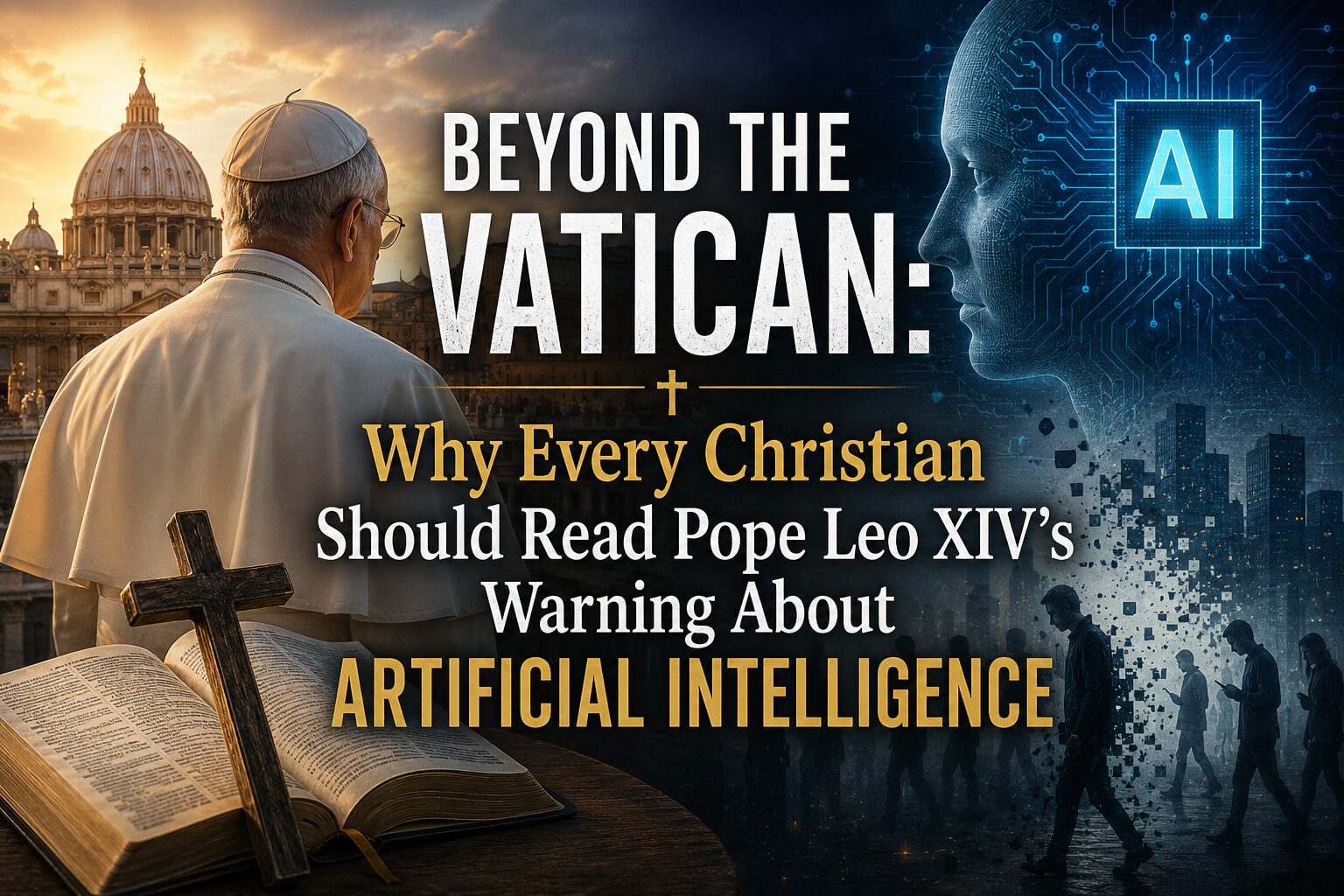
On May 15, 2026, Pope Leo XIV released his first encyclical, Magnifica Humanitas (“Magnificent Humanity”), addressing what he believes is one of the greatest challenges facing modern civilization: Artificial Intelligence.
Whether one agrees with every aspect of Catholic theology or not, the questions raised in this document are questions every follower of Christ should be asking:
- What does it mean to be human?
- Can technology replace human relationships?
- What happens when machines begin making decisions once reserved for people?
- How do Christians defend truth in an age of digital manipulation?
- What role should faith play in a rapidly advancing technological world?
These are not Catholic questions.
They are Christian questions.
And they deserve our attention.
Understanding the Origin of the Letter
To understand why this encyclical matters, we must first understand where it comes from.
The document was intentionally modeled after Rerum Novarum, a landmark encyclical written by Pope Leo XIII in 1891.
At that time, the Industrial Revolution was transforming society. Factories were replacing traditional labor. New technologies were reshaping economies. Workers were being exploited. Entire communities were struggling to adapt.
Leo XIII stepped into that moment and asked:
“How should Christians respond?”
More than a century later, Leo XIV sees a similar turning point.
The Industrial Revolution changed how people worked.
Artificial Intelligence may change what it means to work, communicate, learn, govern, and perhaps even think.
His concern is not primarily technological.
His concern is spiritual.
The question beneath the entire document is this:
Will technology serve humanity, or will humanity begin serving technology?
A Message Protestants Can Appreciate
One of the strongest themes throughout the encyclical is the belief that every human being possesses inherent dignity.
As Evangelical Christians, we recognize this truth immediately because Scripture teaches it clearly.
Genesis 1:27 tells us:
“So God created human beings in his own image. In the image of God he created them; male and female he created them.” (NLT)
Human worth is not based on intelligence.
It is not based on productivity.
It is not based on social status.
It is not based on usefulness.
Human value comes from being created by God.
This is one of the most important contributions the encyclical makes to the modern conversation surrounding AI.
Technology can process information.
Technology can imitate language.
Technology can perform tasks.
But technology cannot bear the image of God.
No algorithm possesses a soul.
No machine possesses conscience.
No computer can repent.
No artificial intelligence can enter into a saving relationship with Jesus Christ.
This distinction matters.
The New Tower of Babel
Perhaps the most powerful biblical image used throughout the letter is the Tower of Babel.
In Genesis 11, humanity united around a common purpose.
At first glance, their project appeared impressive.
They were innovative.
They were ambitious.
They were technologically advanced for their time.
But their motivation was pride.
Their goal was self-exaltation.
They sought to make a name for themselves apart from God.
Many Christians see similar patterns emerging today.
Humanity now possesses tools that previous generations could scarcely imagine.
Artificial intelligence can create content, analyze information, generate images, and automate countless tasks.
These developments are not inherently evil.
The danger emerges when technological capability becomes a substitute for dependence upon God.
The question Christians must continually ask is not:
“What can we build?”
But rather:
“Why are we building it?”
Technology becomes dangerous whenever it convinces humanity that God is no longer necessary.
Truth in the Age of Artificial Intelligence
Another major concern addressed in the encyclical is the growing crisis of truth.
Jesus declared:
“I am the way, the truth, and the life.” (John 14:6, NLT)
Truth is not merely information.
Truth is ultimately found in Christ.
Artificial Intelligence has the potential to spread enormous amounts of knowledge.
It also has the potential to spread enormous amounts of deception.
Deepfakes, manipulated images, synthetic voices, fabricated articles, and algorithm-driven misinformation create challenges previous generations never faced.
Christians therefore have a unique responsibility.
We must become people of discernment.
We must test claims.
We must seek wisdom.
We must refuse to share falsehood simply because it supports our preferred viewpoint.
Followers of Jesus should be among the most careful guardians of truth in society.
Work Is More Than Productivity
One of the most practical sections of the encyclical concerns work.
Modern culture often measures people according to output.
Can they produce?
Can they perform?
Can they generate value?
Scripture offers a different perspective.
Work was established before sin entered the world.
God gave Adam responsibility in the garden before the Fall.
Work is not a curse.
Meaningless toil is a consequence of sin, but meaningful labor remains part of God’s design.
As AI becomes increasingly capable, Christians must remember that people are not valuable because of what they produce.
People are valuable because God created them.
Technology should serve people.
People should never become disposable because technology can perform a task more efficiently.
Where Evangelicals May Differ
While many believers will appreciate the encyclical’s concerns, Protestants should also recognize areas where theological differences remain.
Evangelicals affirm Scripture as the final authority for faith and practice.
Catholics place significant authority in Scripture, Church tradition, and the teaching office of the Church.
Evangelicals generally reject doctrines involving papal authority, Marian devotion, and certain aspects of Catholic sacramental theology.
Those differences are real.
They should not be ignored.
At the same time, disagreement on those matters does not prevent believers from recognizing wisdom when it aligns with biblical truth.
As Christians, we are called to test everything and hold fast to what is good.
The Real Question Facing the Church
At its heart, Magnifica Humanitas is not really a document about Artificial Intelligence.
It is a document about humanity.
More specifically, it is a document about what happens when a culture forgets what it means to be human.
The Bible already provides the answer.
We are not machines.
We are not data.
We are not products.
We are image-bearers.
We were created by God.
We were separated from Him through sin.
We were redeemed through Jesus Christ.
And no technological advancement will ever change those foundational truths.
The future may include artificial intelligence.
The future may include technologies we cannot yet imagine.
But the Church’s mission remains unchanged.
Preach the gospel.
Make disciples.
Love God.
Love people.
And never forget that our hope is not found in human innovation.
Our hope is found in Christ alone.
Final Thoughts
Pope Leo XIV’s encyclical should not be viewed as merely a Catholic document.
It should be viewed as an invitation to a broader Christian conversation.
The questions it raises are not going away.
Artificial Intelligence will continue to reshape society.
The challenge before believers is not whether technology will advance.
It will.
The challenge is whether the Church will remain anchored in the truth of God’s Word while navigating that changing world.
The answer must be yes.
The world may become increasingly digital.
But humanity remains wonderfully and fearfully made by God.