
October 20, 2026 by: Rev. Mac
Examining female leadership, marriage, and church authority under the New Covenant
FAITH OVER FEAR MINISTRY | FEATURE EDITORIAL
A Question Worth Examining
For generations, Christians have debated whether women may serve as senior pastors, lead pastors, or co-pastors alongside their husbands. Some traditions reserve the governing pastoral office for men; others recognize women as pastors. Both appeal to Scripture. The question, then, is not whether a position is familiar or culturally acceptable, but whether our interpretation faithfully reflects the teaching of Jesus and His apostles.
Women in the Biblical Story
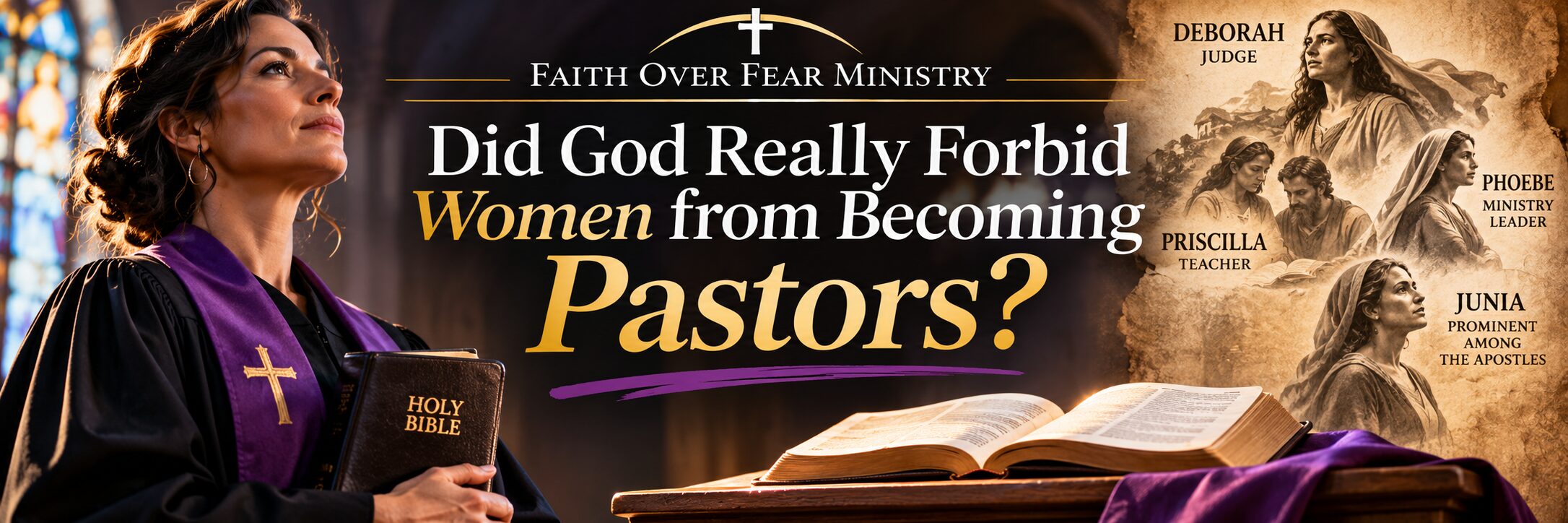
The Old Covenant established a priesthood with defined roles, yet the biblical story also records women exercising remarkable spiritual influence. Deborah served as a judge and prophet (Judges 4–5), Huldah spoke God’s word to leaders (2 Kings 22:14–20), and Miriam was recognized as a prophet (Exodus 15:20). These examples do not settle the New Testament question of the pastoral office, but they challenge the notion that God never entrusted women with public spiritual responsibility.
Jesus, the Apostles, and Women in Ministry
Jesus welcomed women as disciples and theological conversation partners (Luke 10:38–42; John 4:7–30). Women were among the first witnesses to His resurrection (Matthew 28:1–10). At Pentecost, Peter invoked Joel’s promise that sons and daughters would prophesy (Acts 2:16–18). Priscilla and Aquila together explained the way of God more accurately to Apollos (Acts 18:24–26). Paul commended Phoebe, a servant or deacon of the church at Cenchreae, and recognized women among his ministry coworkers (Romans 16:1–7). These texts make the presence and value of women’s ministry unmistakable.
The Texts That Divide Christian Traditions
First Timothy 2:11–12 and 1 Corinthians 14:34–35 are central to the disagreement. Complementarian interpreters commonly understand these passages, together with the elder qualifications in 1 Timothy 3:1–7 and Titus 1:5–9, to reserve the governing teaching office of elder or pastor for qualified men. Egalitarian interpreters contend that Paul’s restrictions addressed particular problems of teaching and order, and must be read alongside his recognition of women praying, prophesying, and serving in ministry (1 Corinthians 11:5). Both positions must grapple with the actual language and context of these passages rather than dismissing inconvenient verses.
What About Husband-and-Wife Co-Pastors?
The New Testament depicts married couples cooperating in ministry, most notably Priscilla and Aquila. It does not, however, explicitly describe a modern husband-and-wife team installed as co-lead pastors over a congregation. That silence should restrain claims on both sides. A ministry partnership is clearly biblical; whether the partners may share the governing pastoral office depends on how one understands the apostolic teaching on elders, teaching authority, and gifts.
A Conclusion Rooted in Scripture
The Church should neither forbid every form of women’s ministry nor assume that the specific question of the elder office is settled by a single example of service. We must welcome the gifts God gives, examine the disputed texts carefully, and distinguish biblical instruction from inherited expectations. Are we defending God’s Word, or merely our preferred interpretation of it? That question calls for humility, serious study, and a commitment to follow Christ even where faithful believers disagree.
Faith Over Fear Ministry | Rooted in Scripture. Centered on Christ. Committed to Truth.