
June 13, 2026 by: Rev. Mac
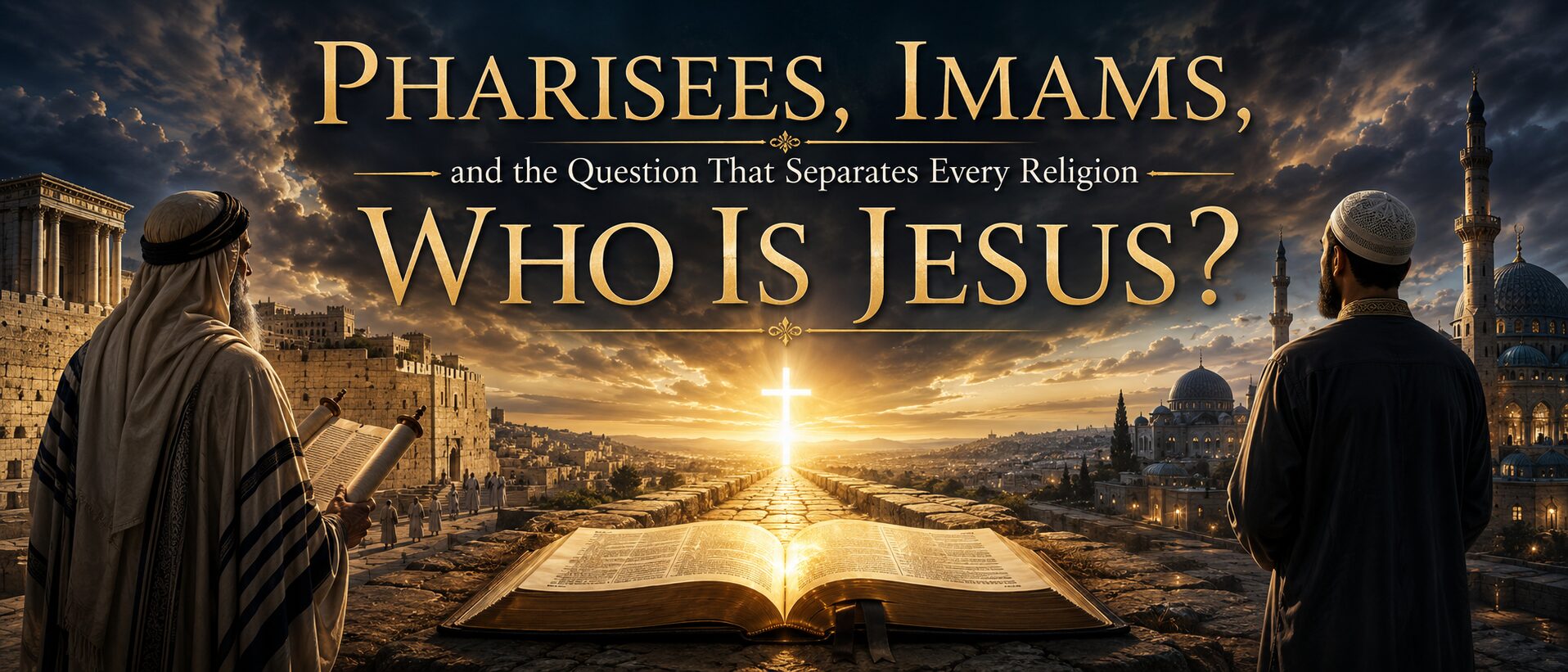
There is one question that cuts through every religious system, every tradition, every pulpit, every synagogue, every mosque, every seminary, every sermon, and every human opinion:
Who is Jesus Christ?
Not merely, “Was He a good teacher?”
Not merely, “Was He a prophet?”
Not merely, “Was He moral, wise, inspiring, or historically important?”
The real question is sharper:
Is Jesus Lord and Savior? Is He the Messiah? Is He the Son of God? Is He the only way to the Father?
That question separates Christianity from every other worldview. It separated Jesus from many of the ancient Pharisees who challenged Him. It separates the Gospel from modern Islamic teaching presented by many imams today. And it separates religious admiration from saving faith.
The issue is not whether people use respectful language about Jesus. Many do. The issue is whether they recognize Him for who He truly is.
The New Testament does not present Jesus as one teacher among many. It presents Him as the eternal Word made flesh, the Lamb of God, the Son of God, the Messiah of Israel, the Savior of the world, and the risen King.
In John 14:6, Jesus says that He is the way, the truth, and the life, and that no one comes to the Father except through Him. In Acts 4:12, the apostles proclaim that salvation is found in no one else. In Philippians 2:9-11, Scripture declares that every knee will bow and every tongue will confess that Jesus Christ is Lord.
That is the line in the sand.
Everything else is religious furniture.
Who Were the Pharisees?
The Pharisees were not Muslims, and modern imams are not Pharisees. They belong to different religions, different time periods, different languages, different histories, and different theological systems.
The Pharisees were a Jewish religious movement active during the Second Temple period and the time of Jesus. Bible Gateway’s Encyclopedia of the Bible describes them as one of the important Jewish sects of the late intertestamental and New Testament periods. They were deeply concerned with the law, purity, tradition, interpretation, and the religious life of Israel.
In the Gospels, some Pharisees appear as opponents of Jesus, while others show curiosity, caution, or even sympathy. Nicodemus, a Pharisee, came to Jesus at night in John 3. Joseph of Arimathea, though not identified as a Pharisee, was part of the Jewish council and became involved in Jesus’ burial. Saul of Tarsus, later the apostle Paul, was himself a Pharisee before encountering the risen Christ.
So we must avoid flattening every Pharisee into one cartoon villain.
Still, the Gospels show a major conflict between Jesus and many Pharisaic leaders. That conflict centered on authority, righteousness, the law, human tradition, and ultimately Jesus’ identity.
In Matthew 23, Jesus rebukes the religious leaders for hypocrisy. In Mark 7, He confronts religious tradition that empties obedience of the heart. In John 5, He exposes leaders who studied the Scriptures but refused to come to Him for life.
That is a terrifying possibility: to know religious words and miss the living Word standing in front of you.
Who Are Imams?
An imam, in the most basic Islamic sense, is a religious leader who leads prayers in a mosque. Oxford defines an imam as a religious man in Islam who leads prayers in a mosque. In many communities, imams may also teach, counsel, preach, provide spiritual guidance, or offer religious interpretation, though their authority and role can vary across countries, traditions, and communities.
Modern imams are not a single global body with one personality or one political agenda. Some are scholars. Some are local prayer leaders. Some are community teachers. Some are deeply traditional. Some are reform-minded. Some are primarily pastoral.
But when speaking broadly about mainstream Islamic teaching, imams generally teach the Islamic view of Jesus: Jesus is honored as a prophet and Messiah, born of Mary, but He is not God, not the Son of God, and not the crucified and risen Savior in the Christian sense. Cambridge’s recent academic treatment of the Islamic Jesus summarizes that Islamic tradition reveres Jesus as a prophet, not as divine, and treats the crucifixion differently from the Christian Gospel.
This is where the separation becomes unavoidable.
Islam can honor Jesus with certain titles and still deny the central truth of who He is.
The First Separation: Pharisees Were Waiting for Messiah, Islam Reinterprets Messiah
The ancient Pharisees lived inside Jewish expectation. They believed in the God of Abraham, Isaac, and Jacob. They read the Hebrew Scriptures. They awaited God’s promises. Many expected some form of messianic deliverance, though Jewish expectations in the first century were varied.
Their problem was not that they had never heard of the Messiah.
Their problem was that many did not recognize the Messiah when He came.
John 1 says Jesus came into the very world He created, but the world did not recognize Him. He came to His own people, and even they rejected Him. Yet to all who believed Him and accepted Him, He gave the right to become children of God.
That is the ancient tragedy.
The Pharisees had the Scriptures. They had prophecy. They had the temple. They had covenant history. They had the promises. But many could not accept a Messiah who came in humility, ate with sinners, healed on the Sabbath, exposed their hearts, and claimed divine authority.
Islam’s separation is different.
Islam does recognize Jesus as Messiah in title, but it redefines what Messiah means. In Islamic teaching, Jesus is Messiah, but not Lord and Savior in the Christian sense. He is not God incarnate. He is not the eternal Son. He is not the atoning sacrifice for sin. He is not worshiped.
So the Pharisaic problem was often rejection of Jesus as the promised Messiah standing before them.
The Islamic problem is redefinition of Jesus as a Messiah without His divine identity, cross, resurrection, and saving lordship.
One missed Him while looking through the lens of tradition.
The other honors Him while denying the fullness of His Gospel identity.
The Second Separation: The Pharisees Had the Old Testament Witness; Imams Have a Later Revelation Claim
Jesus directly confronted religious leaders who searched the Scriptures but refused to see Him as their fulfillment. In John 5:39-40, Jesus tells them that the Scriptures point to Him, yet they refused to come to Him to receive life.
That means the Pharisees’ failure was especially piercing. They possessed the very biblical testimony that prepared the way for Christ.
They had Moses.
They had the prophets.
They had Isaiah.
They had the Psalms.
They had the sacrificial system.
They had the promises of David’s throne.
They had the language of covenant, redemption, priesthood, kingship, and sacrifice.
The road signs were there.
But many still rejected the destination.
Modern imams operate from a different foundation. Islam looks to the Qur’an and the prophetic tradition of Muhammad as authoritative. The Qur’an speaks about Jesus, but it does so in ways that contradict the New Testament witness concerning His deity, crucifixion, resurrection, and sonship. Islamic sources commonly affirm Jesus’ virgin birth and prophetic role, but deny that He is the Son of God or Redeemer in the Christian sense.
From a Christian perspective, that matters deeply.
Galatians 1:8-9 warns that even if someone claims heavenly authority, believers must reject any message that contradicts the Gospel already received. The Gospel is not clay to be reshaped by later revelation. It is the once-delivered truth centered on Christ crucified and risen.
The Pharisees had the older covenant Scriptures and missed their fulfillment.
Islam presents a later claim about Jesus that Christians believe contradicts the apostolic Gospel.
Those are different paths, but they arrive at the same cliff edge: a refusal to confess Jesus as Lord and Savior.
The Third Separation: Religious Law Versus Saving Grace
Both ancient Pharisaic religion and Islamic religious life place strong emphasis on obedience, law, discipline, and religious practice.
That does not mean they are identical. They are not.
The Pharisees were concerned with Torah, purity, Sabbath, tithing, oral tradition, and religious identity within Israel. Imams teach within Islam’s framework of worship, submission, prayer, fasting, charity, law, and community life. These systems differ historically and theologically.
But from a Christian viewpoint, the deeper issue is this:
No religious law can save the sinner.
The Pharisees often clashed with Jesus because He exposed the difference between outward righteousness and inward transformation. In Matthew 23, Jesus condemns religious leaders who looked clean on the outside but were inwardly full of corruption. In Luke 18, Jesus tells a parable of a Pharisee and a tax collector. The Pharisee trusts in his religious performance; the tax collector cries out for mercy. Jesus says the humble sinner, not the self-confident religious man, went home justified before God.
That parable still has teeth.
The Gospel does not say we are saved because we become impressive enough for God. Ephesians 2:8-9 says salvation is by grace through faith, not by works, so no one can boast. Titus 3:5 says God saved us not because of righteous things we had done, but because of His mercy.
That is Christianity’s holy thunder.
We are not saved by religious achievement.
We are saved by Christ.
The Fourth Separation: The Cross
The cross is where the whole world is judged.
To many religious minds, the cross is offensive. It says human beings are too sinful to save themselves. It says no moral system, religious ritual, legal code, or human effort can remove guilt before God. It says the Son of God had to die in our place.
For many first-century Jewish leaders, a crucified Messiah was a scandal. Paul says in 1 Corinthians 1 that the message of the cross was offensive to Jewish expectations and foolishness to Gentile thinking, but to those called by God, Christ is the power and wisdom of God.
The Pharisees who rejected Jesus could not accept that God’s Messiah would suffer, be humiliated, die, and rise.
Islam also rejects the Christian meaning of the cross. Traditional Islamic teaching does not affirm that Jesus died on the cross as the atoning sacrifice for sin. The Cambridge source notes that the crucifixion is recast in Islamic tradition as Jesus being delivered from His enemies, rather than dying and rising as Christianity proclaims.
This is not a minor difference.
Without the cross, there is no atonement.
Without atonement, there is no forgiveness of sins.
Without the resurrection, there is no victory over death.
Without Christ crucified and risen, Christianity is emptied of its heart.
Paul says in 1 Corinthians 15 that if Christ has not been raised, our faith is useless and we are still guilty of our sins.
The Pharisees stumbled over the crucified Messiah.
Islam denies the crucified Savior.
The Gospel proclaims Him.
The Fifth Separation: Human Opinion Versus Divine Revelation
The article’s question asks about “opinions and recognition of Jesus Christ as Lord and Savior.”
That word “opinion” matters.
The Pharisees had opinions about Jesus. Some said He broke Sabbath boundaries. Some accused Him of blasphemy. Some claimed He cast out demons by demonic power. Some tested Him, trapped Him, questioned Him, and plotted against Him.
Modern imams, speaking from Islamic theology, also have defined beliefs about Jesus. They may honor Him as prophet, Messiah, servant of God, and son of Mary, but they do not confess Him as God the Son, crucified and risen Savior, and Lord over all.
But Jesus is not waiting to be validated by human religious opinion.
In Matthew 16, Jesus asks His disciples who people say He is. They give several answers: John the Baptist, Elijah, Jeremiah, or another prophet. Then Jesus asks the sharper question: “But who do you say I am?”
Peter answers that Jesus is the Messiah, the Son of the living God.
Jesus does not call this a lucky guess. He says the Father revealed it.
That is the key.
True recognition of Jesus is not merely intellectual. It is revelation received, faith awakened, and the heart brought under the authority of God.
The Similarity: Both Can Be Near Religious Truth and Still Miss Christ
Here is the uncomfortable part.
Ancient Pharisees and modern imams can both speak with reverence, discipline, and seriousness. Both can value prayer. Both can value moral conduct. Both can lead communities. Both can study religious texts. Both can be respected by sincere people.
But nearness to religion is not the same as nearness to Christ.
The Pharisees show us that a person can know Scripture language and still reject the living Messiah.
Islamic teaching shows us that a person can honor Jesus as prophet and Messiah while still denying Him as Lord, Savior, Son of God, and crucified Redeemer.
That should not make Christians arrogant.
It should make us tremble.
Because the same danger exists in church pews today.
A person can sing about Jesus and still not surrender to Him.
A person can quote Scripture and still resist His lordship.
A person can defend Christianity culturally and still not be born again.
A person can admire Jesus and still refuse to follow Him.
The question is not only what the Pharisee said.
The question is not only what the imam teaches.
The question is what we have done with Jesus.
The Christian Response: Truth Without Hatred
A Christ follower must be able to say clearly: Christianity, Pharisaic rejection of Jesus, and Islamic teaching about Jesus are not the same.
But clarity must not become cruelty.
Jesus wept over Jerusalem. Paul grieved deeply for his Jewish brothers and sisters who did not recognize Christ. The Christian response to Muslims should also be marked by love, prayer, witness, patience, and truth.
We do not win souls by despising people.
We bear witness by lifting up Christ.
The Gospel calls Christians to speak truth, but truth without love becomes noise. Love without truth becomes fog. The Church needs both: a spine of steel and a heart made tender by the cross.
The True Difference Is Jesus
So what is the true separating difference between the ancient Pharisees and modern imams regarding Jesus?
Historically, they are very different.
Religiously, they belong to different worlds.
Theologically, their systems are not the same.
But spiritually, the decisive issue is this:
Neither Pharisaic rejection nor Islamic reinterpretation gives Jesus the full honor the New Testament gives Him.
The Pharisee may say, “He is not the Messiah we expected.”
The imam may say, “He is Messiah, but not God, not Son, not Savior, not crucified Redeemer.”
The Gospel says:
He is the Word made flesh.
He is the Lamb of God.
He is the Son of David.
He is the Son of God.
He is the image of the invisible God.
He is the crucified Savior.
He is the risen Lord.
He is the only way to the Father.
He is King of kings and Lord of lords.
There is no middle ground sturdy enough to stand on forever.
Conclusion: Who Do You Say He Is?
At the end of all comparison, study, history, and theology, Jesus brings the question back to the human heart.
Not, “What do scholars say?”
Not, “What do traditions say?”
Not, “What do religious leaders say?”
Not, “What do crowds say?”
He asks:
Who do you say I am?
That question divided the Pharisees.
That question separates the Gospel from Islam.
That question separates cultural Christianity from true discipleship.
And that question still stands before every soul.
If Jesus is only a teacher, we may admire Him.
If Jesus is only a prophet, we may respect Him.
If Jesus is only a moral example, we may quote Him.
But if Jesus is Lord, then we must bow.
If Jesus is Savior, then we must trust Him.
If Jesus is Messiah, then we must follow Him.
If Jesus is the Son of God, then no religious system, ancient or modern, has the authority to reduce Him.
The difference is not small.
The difference is everything.