
August 14, 2026 by: Rev. Mac
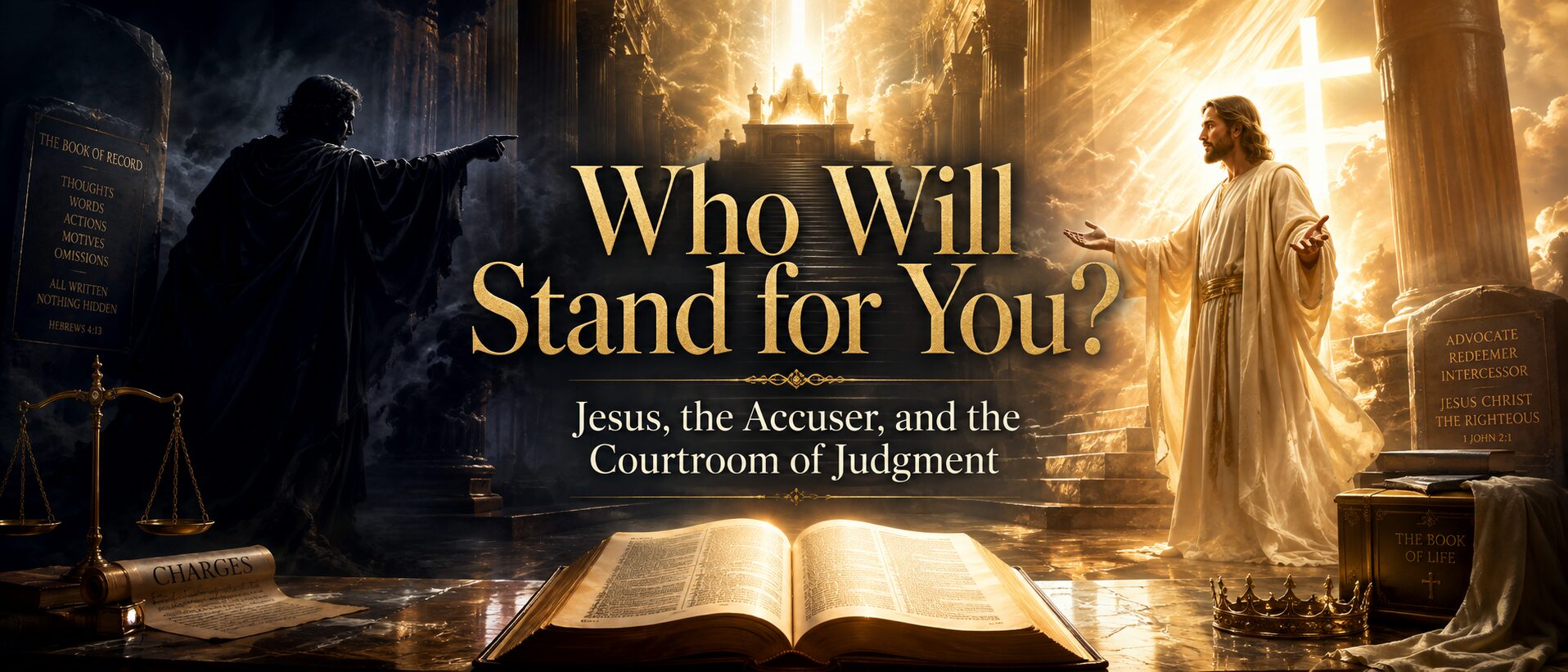
Imagine standing in a courtroom where every hidden thing is finally brought into the light.
No pretending.
No polishing the story.
No carefully edited version of your life.
No public image to hide behind.
No excuses sturdy enough to hold.
Every word.
Every motive.
Every secret.
Every act of selfishness.
Every moment of rebellion.
Every sin we minimized, buried, renamed, defended, or forgot.
Now imagine the devil standing as the prosecutor.
He points to the evidence. He names the failures. He remembers the sins. He accuses with precision. He does not need to invent much, because the truth is painful enough. He knows where we compromised. He knows where we lied. He knows where we chose darkness. He knows where we sinned when no one else was watching.
And then comes the question:
Who will stand for you?
That is not just a courtroom question.
It is an eternal one.
The Accuser Is Real
The Bible describes Satan as an accuser.
In Revelation 12:10, he is called the accuser of God’s people, the one who accuses them before God day and night. In Job 1, Satan appears before God and challenges the integrity of Job. In Zechariah 3, Joshua the high priest stands before the angel of the Lord, and Satan is there to accuse him.
This is one of the enemy’s oldest tactics. He tempts people into sin, then accuses them for the sin he tempted them toward. He whispers rebellion before the act and condemnation after it. He sells poison, then mocks the sickness.
That is how the accuser works.
He wants sin to become your identity.
He wants shame to become your prison.
He wants guilt to become your name.
He wants your past to speak louder than the blood of Jesus.
But the Gospel has a better word.
Jesus Is Our Advocate
The courtroom image is not foreign to Scripture. In 1 John 2:1, believers are told not to sin, but if anyone does sin, “we have an advocate who pleads our case before the Father.” That Advocate is Jesus Christ, the righteous One.
That is the heart of this analogy.
Jesus stands for those who belong to Him.
But we must understand how He stands for us. Jesus does not defend us by pretending our sins were harmless. He does not say, “They never did it.” He does not erase justice by ignoring evil.
Instead, He stands on the finished work of the cross.
Romans 8:34 says Christ Jesus died, was raised to life, sits at God’s right hand, and is pleading for us. Hebrews 7:25 says He lives forever to intercede with God on behalf of those who come to God through Him.
That means the believer is not alone in the courtroom.
Christ is there.
Not as a nervous attorney hoping to find a loophole.
He stands as the crucified and risen Savior whose own blood has already answered the charge.
Jesus Does Not Prove We Are Innocent. He Proves We Are Covered
This is where the analogy needs to be sharpened.
On judgment day, Jesus does not defend believers by saying we never sinned. Scripture says all have sinned and fall short of God’s glorious standard. Romans 3 makes it clear that no one is made right with God by obeying the law perfectly, because none of us have done so.
So the Christian hope is not, “I was innocent.”
The Christian hope is, “Jesus paid for me.”
That is the Gospel.
Romans 5:8 says God showed His great love for us by sending Christ to die for us while we were still sinners. 2 Corinthians 5:21 says God made Christ, who never sinned, to be the offering for our sin, so that we could be made right with God through Him.
This is not spiritual wordplay. This is substitution.
Jesus took what we deserved so we could receive what only He deserved.
He took judgment.
We receive mercy.
He bore wrath.
We receive peace.
He carried sin.
We receive righteousness.
He died our death.
We receive His life.
The devil may point to the record, but Jesus points to the cross.
The Evidence Against Us Is Real
A weak gospel says, “You are not that bad.”
The biblical Gospel says something far stronger: “Your sin is worse than you think, but God’s grace is greater than you can imagine.”
That is why this courtroom analogy matters.
If judgment day is real, then sin is not a small thing. Hebrews 9:27 says every person is destined to die once, and after that comes judgment. Revelation 20 describes the dead standing before God, with books opened, and people judged according to what they had done.
That should sober us.
The Bible does not teach that our lives are meaningless or that our actions do not matter. God sees. God knows. God judges rightly. Nothing is hidden from Him.
Hebrews 4:13 says nothing in all creation is hidden from God, and everything is exposed before His eyes.
That means judgment is not based on partial evidence.
God does not miss anything.
But There Is Another Book
Revelation also speaks of the Book of Life.
This is where hope enters the courtroom.
For those who have rejected Christ, judgment rests on their own works. For those who have received Christ, their names are written in the Lamb’s Book of Life. Their confidence is not their moral résumé. Their confidence is the Lamb.
The believer does not walk into judgment saying, “I hope I did enough.”
The believer says, “Jesus is enough.”
That is why Romans 8:1 is such good news: there is no condemnation for those who belong to Christ Jesus.
No condemnation does not mean no sin ever happened. It means sin has been judged in Christ for those who belong to Him. The penalty has been paid. The debt has been canceled. The record has been nailed to the cross.
Colossians 2:14 says God canceled the record of charges against us and took it away by nailing it to the cross.
That is the sound of chains hitting the courtroom floor.
Repentance Is Not a Legal Trick
This truth must not be twisted.
Some may hear this and think, “So I can live however I want, then hire Jesus as my defense attorney at the end.”
That is not Christianity.
Jesus is not a last-minute legal strategy. He is Lord.
Repentance is not gaming the system. Repentance is turning from sin and turning to God. True faith does not use grace as permission to keep rebelling. True faith receives grace as the power to become new.
Romans 6 asks whether believers should keep on sinning so God can show more grace. The answer is absolutely not. Since we have died to sin, we cannot continue living in it as though nothing changed.
A person who truly receives Christ does not simply want forgiveness from sin’s penalty. They want freedom from sin’s power.
Jesus does not merely defend the guilty.
He transforms the guilty.
The Devil Accuses, but Jesus Intercedes
The difference between Satan’s accusation and Jesus’ intercession is the difference between death and life.
Satan accuses to destroy.
Jesus intercedes to save.
Satan exposes sin to produce despair.
Jesus exposes sin to bring repentance and healing.
Satan says, “Look what you did. You are finished.”
Jesus says, “Look what I did. It is finished.”
That phrase, spoken by Jesus from the cross in John 19:30, is the thunder of the Gospel. The payment was complete. The sacrifice was sufficient. The Lamb had done what no sinner could do.
The courtroom of eternity is not won by human excuses.
It is won by the blood of Jesus.
Jesus Is Also the Judge
Here is another important correction to the analogy: Jesus is not only the defense attorney.
Scripture also teaches that Jesus is Judge.
John 5 says the Father has given the Son authority to judge. Acts 17 says God has set a day for judging the world with justice by the Man He has appointed, and He proved this by raising Him from the dead. 2 Timothy 4 refers to Christ Jesus as the One who will judge the living and the dead.
That means the One who stands for believers is also the One before whom every person must stand.
This makes grace even more astonishing.
The Judge stepped down from the bench, entered human history, took on flesh, lived without sin, died for sinners, rose from the grave, and now offers mercy before the final verdict.
The Judge became the Savior.
That is not religion.
That is rescue.
Do You Want Jesus Standing for You?
So the question becomes personal:
Do you want Jesus Christ standing for you on judgment day?
Not religion.
Not church attendance.
Not family tradition.
Not vague spirituality.
Not good intentions.
Not comparison to people worse than you.
Not charitable acts stacked against secret sins.
Jesus.
Do you belong to Him?
Have you repented of your sin?
Have you trusted Him as Savior?
Have you surrendered to Him as Lord?
Have you received the grace He purchased with His blood?
Because when the accuser begins reading the record, nothing else will be enough.
Your reputation will not be enough.
Your morality will not be enough.
Your excuses will not be enough.
Your religious background will not be enough.
Your personal sincerity will not be enough.
Only Christ.
The Verdict for Those in Christ
For the believer, judgment day is not a denial of justice. It is the final public triumph of grace.
The enemy may accuse, but he cannot overturn the cross.
He may point to the sin, but Jesus points to the blood.
He may name the failure, but Jesus names the redeemed.
He may say, “Guilty.”
But heaven answers, “Covered.”
Not because sin did not matter.
Because Jesus mattered more.
The Christian does not stand forgiven because God became careless with justice. The Christian stands forgiven because justice fell on Christ, and mercy now flows to all who are united with Him by faith.
That is why the Gospel is not a motivational message.
It is an eternal verdict.
Conclusion: Choose Your Counsel Before the Courtroom
One day, every life will stand before God.
The courtroom will not be impressed by image, wealth, titles, platforms, excuses, achievements, or religious performance. The books will be opened. The truth will be known. The accuser will have plenty to say.
But for those who are in Christ, the final word will not belong to the accuser.
It will belong to Jesus.
He is the Advocate.
He is the Mediator.
He is the Lamb.
He is the Savior.
He is the risen Lord.
He is the righteous Judge.
He is the King of kings.
So do not wait until judgment day to wonder who will stand for you.
Run to Christ now.
Confess your sin.
Repent.
Believe the Gospel.
Receive His grace.
Follow Him as Lord.
Because when eternity opens the courtroom doors, only one question will matter:
Is Jesus Christ standing for you?