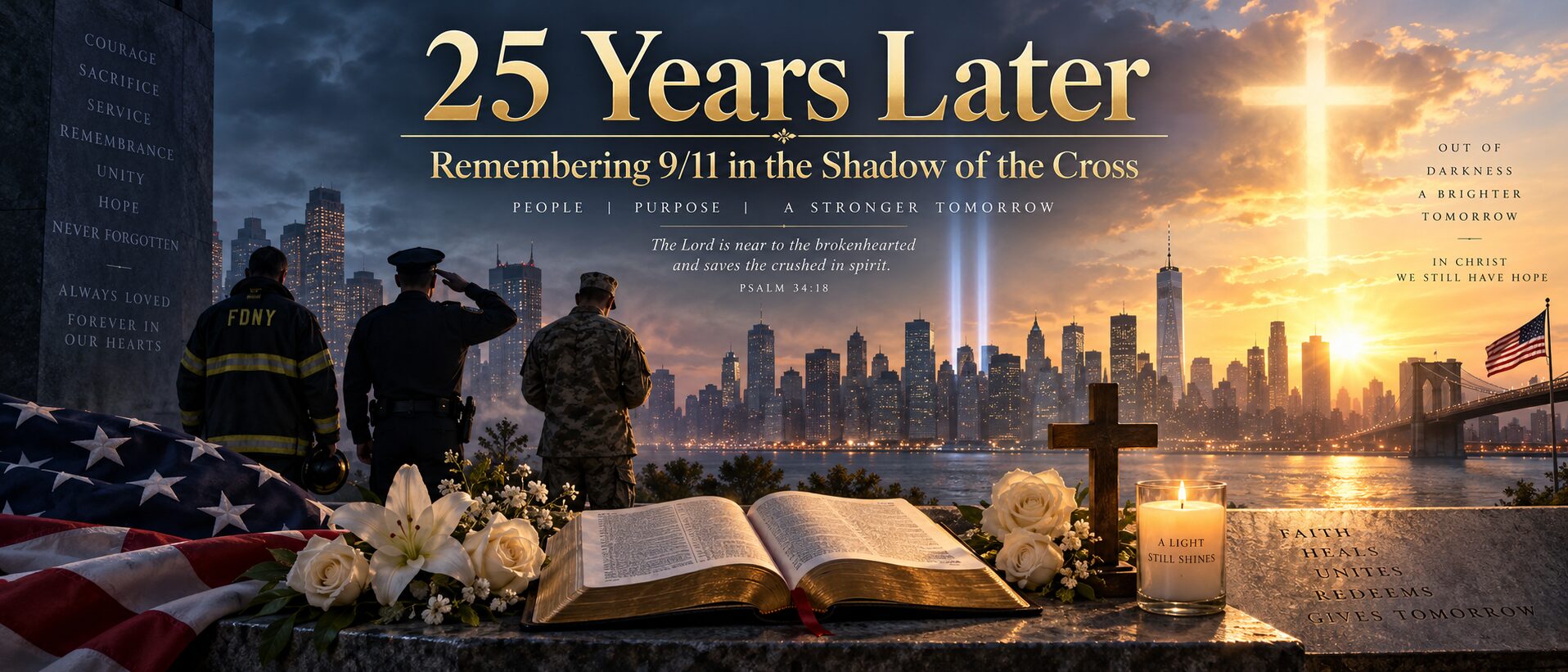
September 11, 2026 by: Rev. Mac
There are days history refuses to release.
September 11, 2001, is one of them.
For those who lived through it, watched it unfold on television, served before it, served through it, responded after it, lost someone because of it, or carried its weight into war zones, firehouses, police stations, churches, airports, hospitals, homes, and military bases, 9/11 is not merely an event on a calendar. It is a wound with a timestamp.
A clear Tuesday morning became a national scar.
Twenty-five years later, America still remembers the attacks that killed nearly 3,000 people in New York City, at the Pentagon, and near Shanksville, Pennsylvania. The National September 11 Memorial & Museum’s 25th anniversary commemoration includes the reading of the names of those killed in the September 11 attacks and the 1993 World Trade Center bombing, reminding the nation that remembrance must remain personal, not merely historical.
We remember the office workers who never came home.
We remember the firefighters climbing stairs while others fled downward.
We remember the police officers, paramedics, chaplains, service members, airline crews, passengers, families, and strangers who became neighbors in the smoke.
We remember the Pentagon.
We remember Flight 93.
We remember the soundless horror of watching towers fall.
We remember the silence after the sky closed.
And for many who served in uniform before, during, and after the attacks, 9/11 became a hinge in life. There was life before, and life after. Deployments changed. Missions changed. Families changed. Bodies changed. Minds changed. Faith changed.
Some lost peace.
Some lost friends.
Some lost years.
Some lost pieces of themselves they still cannot fully name.
And yet, in the shadow of that terrible day, many also found Christ.
That does not make the tragedy good.
It means God is still able to bring resurrection life into places where death tried to write the final sentence.
God Was Not Absent From the Ashes
When tragedy strikes, one of the first spiritual questions people ask is, “Where was God?”
It is not a weak question. It is a human one.
The Bible does not mock grief. Scripture gives language to sorrow. Psalm 34:18 says the Lord is close to the brokenhearted and rescues those whose spirits are crushed. Matthew 5:4 says God blesses those who mourn, for they will be comforted. Romans 12:15 tells believers to weep with those who weep.
Christian faith does not require us to pretend the smoke did not burn.
God was not absent from the ashes. He was present with the grieving, present with the dying, present with the rescuers, present with the chaplains, present with those trapped in fear, present with those praying on sidewalks, present with families waiting for calls that never came.
The cross teaches us that God does not stand far away from suffering. In Jesus Christ, God entered suffering. He bore injustice. He carried grief. He absorbed evil without becoming evil. He was wounded, pierced, mocked, and killed. Yet death did not get the last word.
That is why Christians can remember 9/11 honestly without surrendering to despair.
We do not say, “It was not that bad.”
We say, “It was evil, and God is still greater.”
A Nation Hurt, a Nation Humbled
9/11 hurt America in ways still being measured.
It changed national security, foreign policy, airport travel, military service, intelligence gathering, public fear, political rhetoric, and the way many Americans understood vulnerability. Pew Research Center reported that, in 2016, 76% of U.S. adults named the September 11 attacks as one of the ten historical events of their lifetime that had the greatest impact on the country.
That impact was not abstract. It entered kitchens, barracks, churches, mosques, synagogues, schools, and bedrooms where children asked parents whether another attack would come.
For those serving in the military, law enforcement, firefighting, emergency medicine, intelligence, and chaplaincy, 9/11 was more than a national event. It was a calling intensified. It meant longer deployments, new enemies, new griefs, new burdens, and sometimes new trauma.
Some served because of 9/11.
Others were already serving and found the meaning of their service changed overnight.
Jesus said in John 15:13 that there is no greater love than to lay down one’s life for one’s friends. On 9/11, the nation saw that kind of courage in ordinary people wearing uniforms, work clothes, flight attendant scarves, business suits, and firefighter gear.
The FDNY has continued to commemorate the 343 members who died on September 11, 2001, as well as those who later died from World Trade Center-related illnesses. That continuing toll reminds us that sacrifice did not end when the towers fell.
Some wounds keep reporting for duty long after the cameras leave.
Religion After 9/11: Revival, Fear, and Tension
After 9/11, many Americans prayed.
Churches filled. People searched for meaning. Families gathered. Chaplains were called. Candles were lit. Flags appeared on porches. Strangers held each other. Political divisions, at least for a moment, seemed smaller than shared grief.
Pew reported that in November 2001, 78% of Americans said religion’s influence in American life was increasing, more than double the share who said so eight months earlier.
That moment revealed something important: suffering often exposes spiritual hunger.
When the illusion of control collapses, people begin asking eternal questions. Where is God? What matters? What happens after death? Is evil real? Is judgment real? Is heaven real? Can peace survive grief? Can forgiveness exist where violence has shattered everything?
For many, those questions became doorways to Christ.
Some found Jesus in a chapel before deployment.
Some found Him in recovery from trauma.
Some found Him after losing someone.
Some found Him when patriotism alone could not heal the soul.
Some found Him when fear finally drove them to prayer.
Some found Him through the quiet witness of believers who served, comforted, and endured.
But 9/11 also intensified religious tensions. Muslims, Sikhs, Arabs, and South Asians in America faced suspicion, discrimination, and in some cases violence. Pew notes that reported anti-Muslim hate crimes spiked to record levels in 2001, based on FBI hate crime data.
Christians must be honest about both realities.
A terrorist attack committed by al-Qaida was evil. The murder of innocents was evil. But so is hatred against innocent neighbors. So is revenge against people who did not commit the crime. So is confusing righteous grief with permission to dehumanize.
The Gospel does not allow us to answer evil with evil.
Romans 12:21 says not to let evil conquer us, but to conquer evil by doing good.
That is not weakness.
That is spiritual warfare with clean hands.
Freedom Became a Heavier Word
After 9/11, freedom became a heavier word.
Americans began speaking differently about religious liberty, national security, surveillance, immigration, public safety, civil liberties, and the role of religion in public life. The USA PATRIOT Act, passed after the attacks, expanded government surveillance powers and intensified national debate about the balance between security and civil liberties.
That debate still matters.
A nation can be wounded and still need wisdom. A nation can defend itself and still need conscience. A nation can seek justice and still need humility before God.
The Bible never teaches that governments should ignore evil. Romans 13 describes governing authorities as having responsibility to restrain wrongdoing. But Scripture also warns against fear becoming an idol, power becoming unchecked, and human strength becoming our savior.
Psalm 20:7 says some nations boast of chariots and horses, but God’s people boast in the name of the Lord.
For America, 9/11 forced a hard question: Can we pursue security without losing our soul?
For the Church, the question was even sharper: Can we remain faithful to Christ when fear wants to disciple us?
Unity Was Real, But It Was Fragile
One of the positive things that came after 9/11 was unity.
For a moment, America remembered how to mourn together. We saw firefighters from one state drive toward another. We saw churches open their doors. We saw blood donations, relief funds, rescue workers, prayer gatherings, and a flood of volunteers. We saw people honor sacrifice. We saw neighbors ask each other, “Are you okay?”
Reuters reported near the 25th anniversary that most Americans still look back on September 11 as an event that unified the country, and 75% say it had a major impact on the nation.
But unity built only on tragedy fades.
Unity built on Christ endures.
That is the lesson believers must carry forward. National unity is precious, but it is not the same as spiritual revival. Patriotism can gather people beneath a flag. Only Christ can reconcile hearts beneath the cross.
Ephesians 2 teaches that Christ Himself is our peace, the One who breaks down dividing walls. That does not erase nations, histories, griefs, or responsibilities. But it does remind us that the deepest healing is not political. It is spiritual.
America needed unity after 9/11.
America still needs repentance.
America still needs humility.
America still needs Jesus.
For Those Who Served, the Story Did Not End That Day
There is a particular grief carried by those who served before, through, and after the attacks.
Some were already in uniform on September 11. Some joined because of what they saw. Some deployed again and again. Some came home to families who loved them but could not fully understand what had changed. Some still carry names, dates, sounds, smells, memories, injuries, guilt, anger, and silence.
The article must make room for them.
The Bible does.
Psalm 147:3 says God heals the brokenhearted and bandages their wounds. 2 Corinthians 1:3-4 calls God the Father of compassion and the source of all comfort, who comforts us in our troubles so we can comfort others.
That is not sentimental language. That is battlefield theology.
God does not waste healed wounds.
Many veterans, first responders, chaplains, and survivors have become living witnesses of grace. Their pain did not disappear, but it was placed in the hands of Christ. Their memories did not vanish, but their lives found a greater anchor. Their service did not save their souls, but it became a place where the Savior met them.
Some found Christ because they reached the end of themselves.
That is often where grace begins.
What Good Can Come From Such Loss?
This question must be handled carefully.
Christians should never speak of tragedy in a way that sounds casual, tidy, or cheaply triumphant. We should not rush grieving people toward a lesson before we have sat with them in lament.
But Scripture does teach that God can bring good out of evil.
Genesis 50:20 records Joseph telling his brothers that they intended harm against him, but God intended it all for good, to save many lives. Romans 8:28 teaches that God causes everything to work together for the good of those who love Him and are called according to His purpose.
That does not mean everything that happens is good.
It means God is sovereign enough to work even through what is evil, painful, unjust, and devastating.
So what good came after 9/11?
Not good that cancels grief.
But good that testifies that darkness could not own the whole story.
People prayed.
Families held tighter.
Churches opened wider.
Chaplains ministered in sacred ruins.
First responders modeled sacrifice.
Service members answered the call.
Strangers became neighbors.
Some who had wandered from God came home.
Some who had never known Christ began seeking Him.
Some discovered that life is brief, eternity is real, and Jesus is not optional.
James 4:14 says life is like the morning fog, here a little while and then gone.
9/11 made that truth impossible to ignore.
Christ in the Rubble
The cross of Christ gives Christians a unique way to remember days like 9/11.
We do not deny evil.
We confront it.
We do not worship suffering.
We bring it to the Savior who suffered.
We do not claim death is harmless.
We proclaim that death has been defeated.
In John 16:33, Jesus tells His followers they will have many trials and sorrows in this world, but they can take heart because He has overcome the world. That verse does not promise a world without towers falling, wars starting, bodies breaking, or nations grieving.
It promises a Savior greater than all of it.
That is why the Christian message on the 25th anniversary of 9/11 is not merely “Never Forget.”
It is also “Look to Christ.”
Never forget the lives lost.
Never forget the courage shown.
Never forget the families grieving.
Never forget the responders still suffering.
Never forget the service members changed forever.
Never forget the cost of hatred.
Never forget how fragile life is.
But also never forget that Jesus is near to the brokenhearted.
Never forget that judgment belongs to God.
Never forget that evil does not get the last word.
Never forget that eternity is real.
Never forget that salvation is found in Christ alone.
A Warning Against Hatred
A remembrance article must also speak plainly: Christians cannot honor 9/11 rightly while carrying hatred in their hearts.
The terrorists who committed those attacks were responsible for evil. Justice matters. Truth matters. National defense matters. Protecting innocent life matters.
But the Gospel forbids us from turning grief into blanket hatred against entire peoples, religions, ethnicities, or neighbors. Every person is made in the image of God. Every person needs salvation. Every person must be treated with dignity.
Jesus commands His followers in Matthew 5:44 to love their enemies and pray for those who persecute them.
That command is not easy.
It is cruciform.
It takes the shape of Jesus praying for His executioners.
Christians can reject false teaching, oppose terrorism, defend the innocent, and proclaim Christ as the only Savior without becoming cruel. Truth does not need venom to be strong.
The cross is sharp enough.
The Revival We Still Need
After 9/11, there was a surge of prayer, church attendance, and spiritual openness. But America’s deeper need was never temporary emotion. It was repentance and revival.
The same is true now.
Twenty-five years later, we do not need only ceremonies. We need surrender. We do not need only memorials. We need mercy. We do not need only patriotic songs. We need holy lives. We do not need only to remember where we were when the towers fell. We need to ask where we are standing before God today.
2 Chronicles 7:14 says that if God’s people humble themselves, pray, seek His face, and turn from their wicked ways, He will hear from heaven, forgive their sins, and restore their land.
That verse is often quoted in national moments, but it begins with God’s people.
Revival does not begin with “them.”
It begins with us.
The Church must repent of coldness, division, prayerlessness, pride, fear, compromise, and spiritual sleep. We must recover the urgency of the Gospel. We must minister to veterans, survivors, first responders, widows, orphans, grieving families, and those still trapped in trauma. We must proclaim hope without exploiting pain.
America does not merely need to be safer.
America needs to be saved.
And salvation has only one name: Jesus Christ.
Conclusion: Never Forget, But Also Never Drift
On this 25th anniversary, we remember.
We remember the smoke.
We remember the names.
We remember the calls.
We remember the rubble.
We remember the courage.
We remember the grief.
We remember the unity.
We remember those who served.
We remember those who never came home.
But remembrance must become more than memory.
It must become a summons.
A summons to honor life.
A summons to reject hatred.
A summons to serve faithfully.
A summons to love our neighbors.
A summons to pray for our nation.
A summons to care for those still wounded.
A summons to seek Christ while He may be found.
9/11 showed us how quickly the world can change.
The Gospel shows us where hope does not change.
Jesus Christ is the same yesterday, today, and forever. He is near to the brokenhearted. He is Lord over history. He is Judge of evil. He is Savior of sinners. He is the resurrection and the life.
The towers fell.
The smoke rose.
The nation wept.
But Christ remained.
And twenty-five years later, He is still calling the weary, the wounded, the grieving, the guilty, the angry, the afraid, and the searching to come to Him.
Never forget.
And never drift from the only One who can redeem what evil tried to destroy.