
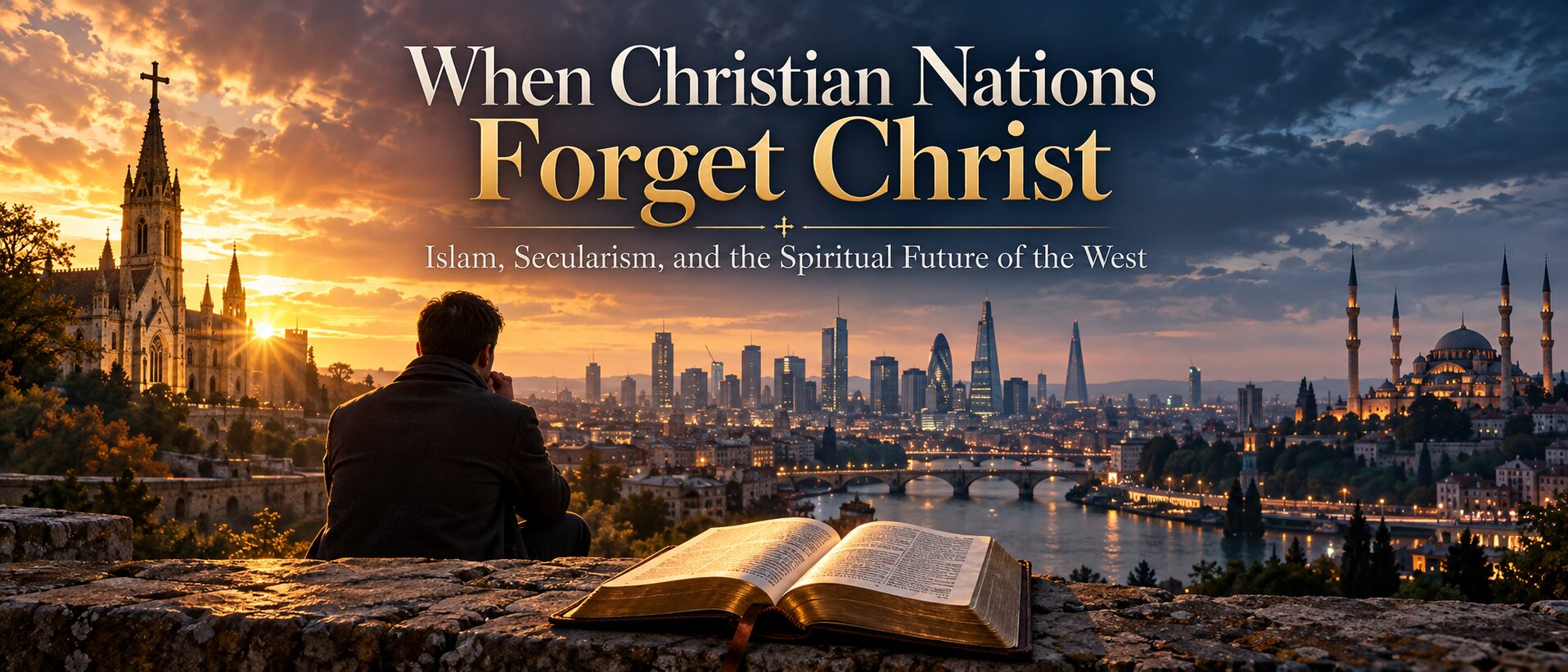
September 17, 2026 by: Rev. Mac
A nation does not lose Christ because a mosque is built.
A nation loses Christ when churches empty, homes stop praying, children are not discipled, pastors trade courage for comfort, believers become spectators, and the Gospel becomes a cultural memory instead of a living fire.
That distinction matters.
Across the Western world, many Christians are asking hard questions. Why are historically Christian nations becoming less Christian? Why are churches closing while other religious communities appear more visible? Why does Christianity seem to be fading from public life in countries once shaped by the Bible, the Church, and Christian moral imagination?
Some point immediately to Islam, immigration, refugees, and mosques. They see demographic change and assume a hostile takeover is underway.
But the truth is more sobering.
The greatest threat to Christianity in the West is not that Muslims are faithfully gathering in mosques.
The greater threat is that many Christians have stopped faithfully gathering around Christ.
The Question Beneath the Fear
It is not wrong for Christians to care about the spiritual direction of a nation. Scripture calls believers to discern the times, guard truth, protect religious liberty, love their neighbors, and proclaim Christ clearly.
But fear can distort our vision.
The Bible never commands Christians to panic because another religion exists nearby. It commands us to be faithful witnesses. Jesus did not say, “You are the panic of the world.” He said His followers are the salt of the earth and the light of the world.
That image is important.
Salt does not complain that decay exists. Salt resists decay.
Light does not curse the darkness. Light shines.
When Christians see their society drifting from Christ, the first biblical question should not be, “Who can we blame?”
The first question should be, “Where did we stop shining?”
What Is Actually Happening in the U.K.?
England and Wales offer one of the clearest examples of religious change in the West.
According to the 2021 Census, for the first time, less than half of people in England and Wales described themselves as Christian: 46.2%, down from 59.3% in 2011. But the most important number is not Islam. The second-largest category was “No religion,” which rose from 25.2% in 2011 to 37.2% in 2021. The Muslim population also increased, from 4.9% in 2011 to 6.5% in 2021, but that increase was much smaller than the rise of “No religion.”
That means the main story in England and Wales is not simply “Islam replacing Christianity.”
The main story is de-Christianization through secularization.
London is more religiously diverse than the rest of England. In 2021, Christianity was still the most common religious response in London at 40.7%, while Muslims made up 15.0% of London’s population, up from 12.6% in 2011. Some local authorities had much higher Muslim shares, such as Tower Hamlets at 39.9%, but those are local concentrations, not evidence that the entire nation has become Islamic.
That distinction matters because truth matters.
Christians should be bold, but never careless with facts.
If the Church misdiagnoses the disease, we will prescribe the wrong medicine.
The U.K. did not become less Christian mainly because mosques were built. It became less Christian because millions of people walked away from identifying with Christianity at all.
What About the United States?
The United States is also changing, but the facts do not support predictions that America will become a Muslim-majority nation in five years.
Pew Research Center’s 2023-24 Religious Landscape Study found that 62% of U.S. adults identify as Christian, down from 78% in 2007 and 71% in 2014. Pew also found that 1.2% of U.S. adults identify as Muslim. The largest long-term shift has been the decline of Christian affiliation and the rise of religious disaffiliation, not a massive conversion of the country to Islam.
Pew has projected that Muslims may reach about 2.1% of the U.S. population by 2050. That would make Islam larger in America than it is today, but still far from a national majority. Pew also estimated that about as many Americans become Muslim as leave Islam.
So what will the United States look like in five years if current patterns continue?
Not Islamic.
More secular.
More religiously mixed.
More spiritually confused.
More in need of courageous, compassionate, Bible-rooted Christian witness.
That may not feed fear as dramatically as the phrase “hostile takeover,” but it is closer to the truth.
Former Christian Lands and the Long History of Religious Change
It is historically true that many lands that were once heavily Christian are now majority Muslim. North Africa, Egypt, Syria, parts of the Levant, and Asia Minor were once major centers of Christian life, theology, monasticism, bishops, councils, and churches.
Islam expanded rapidly after the seventh century. OpenStax World History notes that early Arab-Muslim armies conquered much Byzantine and Persian territory, moving through Iraq, Syria, Iran, and Egypt during the early Islamic conquests. It also describes the Middle East at that time as predominantly Christian in many regions.
Egypt is one example. Cambridge’s historical treatment notes that the Arab conquest initiated a long cultural transformation involving a passage from Christianity, Coptic, and Greek toward Islam and Arabic.
But history is not simple enough to reduce to one sentence. Religious change occurred through conquest, taxation, social pressure, political advantage, intermarriage, language change, trade, cultural assimilation, and genuine conversion over centuries. It was not usually a matter of one generation allowing a mosque to be built and then suddenly losing Christian identity.
That does not mean Christians should ignore history.
It means we should tell the truth about history.
Ancient Christian communities in North Africa and the Middle East remind us that churches can decline. Civilizations can change. Once-vibrant centers of Christian life can become shadows of what they were.
But they also remind us of something else: the Church’s strength is never guaranteed by culture alone.
A Christian-looking society is not the same thing as a Christ-following people.
Mosques, Religious Liberty, and Christian Integrity
Some Christians argue that allowing mosques to be built freely in Western nations is a sign of weakness.
But Christians must be very careful here.
If we want freedom to build churches, preach the Gospel, open Christian schools, publish Bibles, send missionaries, disciple children, and worship without state interference, then we cannot build our argument on denying religious liberty to others simply because we disagree with them.
Christianity does not need government favoritism to survive.
It needs faithful Christians.
The early Church grew under hostile conditions without political privilege. The apostles preached Christ in a world filled with pagan temples, imperial cults, false gods, persecution, and moral darkness. They did not demand Rome silence every rival religion before they obeyed the Great Commission. They preached Jesus.
That does not mean Christians should be naïve about Islamic theology, sharia-based political movements, religious extremism, or anti-Christian persecution in Muslim-majority countries. Those realities deserve honest discussion.
But the answer to religious difference in America is not fear-driven suppression.
The answer is Gospel proclamation, strong churches, wise laws, religious liberty, public courage, and Christian discipleship.
The Biblical Diagnosis: The Church Must Wake Up
Scripture repeatedly warns God’s people not to drift.
In Revelation 2 and 3, Jesus speaks to churches that were loveless, compromising, tolerant of false teaching, spiritually dead, and lukewarm. He does not tell them to blame outsiders. He tells them to repent.
That is the word the Western Church must recover.
Repent.
Not merely protest.
Not merely vote.
Not merely complain.
Not merely post warnings online.
Not merely fear demographic change.
Repent.
Return to first love.
Return to prayer.
Return to Scripture.
Return to holiness.
Return to evangelism.
Return to courage.
Return to discipling children.
Return to caring for widows, orphans, refugees, veterans, prisoners, and the poor.
Return to proclaiming Christ crucified and risen.
The Church does not lose ground because Muslims exist.
The Church loses ground when Christians stop acting like Christians.
What Should Christians Say About Islam?
Christians must speak truthfully about Islam. Islam denies the central claims of the Gospel: that Jesus is God the Son, crucified for sin, risen from the dead, Lord over all, and the only way to the Father. That is not a minor disagreement.
John 14:6 presents Jesus as the only way to the Father. Acts 4:12 says salvation is found in no one else. 1 John 4 warns believers to test the spirits by the truth of Christ.
So Christians should not pretend Islam and Christianity teach the same message.
They do not.
But Christians must also remember that Muslims are people made in the image of God. They are not demographic threats to be despised. They are neighbors to be loved, souls to be reached, and people for whom Christ died.
A Christian can reject Islamic doctrine while loving Muslim people.
A Christian can oppose religious coercion while defending religious liberty.
A Christian can critique sharia-based political ideology while sharing the Gospel with humility.
A Christian can be firm without being cruel.
Truth does not require hatred as fuel.
The Danger of Fear-Based Christianity
Fear can make Christians sound more like cable news than Christ.
Fear turns neighbors into enemies.
Fear turns mission fields into threats.
Fear turns discernment into suspicion.
Fear turns courage into anger.
Fear makes Christians forget that Jesus is still Lord.
The Bible says God has not given us a spirit of fear and timidity, but of power, love, and self-discipline. The NLT wording of 2 Timothy 1:7 is especially clear on this point.
Power.
Love.
Self-discipline.
That is the Christian posture.
Not panic. Not hatred. Not silence. Not compromise.
The Church should be clear-eyed about spiritual deception and cultural change, but it should not become frantic. Jesus is not pacing heaven because a mosque was built in a Western city. He is calling His Church to be faithful.
What America Could Look Like in Five Years
If current trends continue, America in five years will likely not be majority Muslim. The evidence does not support that claim. Pew’s data shows Muslims remain a small share of the U.S. population, while Christianity remains the largest religious identity and the unaffiliated remain one of the major growing forces.
The greater question is not whether America will become Islamic by 2031.
The greater question is whether American Christianity will become spiritually hollow.
Will churches preach repentance?
Will parents disciple children?
Will pastors teach doctrine?
Will believers share Christ with Muslims, atheists, secular neighbors, and nominal Christians?
Will we pray for revival instead of only fearing decline?
Will we live holy lives in an unholy age?
Will we defend religious liberty without surrendering Gospel conviction?
Will we love refugees while proclaiming Christ as Lord?
That is the battlefield.
Not merely immigration policy.
Not merely mosque construction.
Not merely demographic anxiety.
The battlefield is worship.
Who has the heart of the nation?
Who has the heart of the Church?
Who has your heart?
A Better Christian Response
The Christian response to religious change should include five commitments.
First, tell the truth. Do not exaggerate numbers. Do not spread fear. Do not call every Muslim neighbor an invader. Do not confuse local demographic change with national takeover.
Second, guard the Gospel. Jesus is not one option among many. He is Lord and Savior. Christians must clearly proclaim salvation through Christ alone.
Third, strengthen the Church. Build churches that preach Scripture, practice prayer, form disciples, serve families, and train believers to witness.
Fourth, love the neighbor. Muslim immigrants, refugees, and families are not beyond the reach of Christ. They should encounter Christians who speak truth with courage and love with visible sincerity.
Fifth, recover holy confidence. The Gospel has survived empires, persecutions, heresies, crusades, revolutions, secularism, and false religions. Christ does not need fearful Christians. He calls faithful ones.
Conclusion: The West Does Not Need Less Islam as Much as It Needs More Christ
The spiritual future of America and the West will not be secured by fear.
It will not be secured by resentment.
It will not be secured by blaming immigrants.
It will not be secured by nostalgia for a Christian culture that often had the name of Christ without the life of Christ.
The future will be shaped by whether the Church returns to Jesus.
If Christians are worried about mosques filling, we should ask why churches are emptying.
If Christians are worried about Muslim families teaching their children the Qur’an, we should ask whether Christian families are teaching their children the Bible.
If Christians are worried about Islam’s public confidence, we should ask why so many believers are embarrassed by the Gospel.
If Christians are worried about religious change, we should recover the Great Commission.
Jesus did not command His Church to fear the nations.
He commanded His Church to disciple them.
The West does not need Christians who merely complain about darkness.
It needs Christians who shine.
It needs churches filled with prayer.
Homes filled with Scripture.
Parents filled with courage.
Pastors filled with conviction.
Believers filled with the Holy Spirit.
And a people who can look at every neighbor, including the Muslim neighbor, and say with both love and urgency:
Jesus Christ is Lord.
That is not surrender.
That is mission.