September 26, 2026 by: Rev. Mac
Music is one of the most powerful gifts God has given humanity.
A melody can awaken memory before a sentence can explain it. A chorus can settle into the heart before a sermon reaches its first point. A song can carry grief, joy, repentance, longing, victory, surrender, and hope in a way ordinary speech often cannot.
That is why Scripture gives music such a central place in worship.
The Psalms are songs. Israel sang after deliverance. David appointed musicians for temple worship. Paul tells believers to sing psalms, hymns, and spiritual songs to God with thankful hearts. Worship is not an accessory to Christian faith. It is part of the life of God’s people.
But because music is powerful, it can also be dangerous when separated from truth.
A beautiful song can carry biblical doctrine into the soul.
A beautiful song can also carry spiritual error past the guards of discernment.
That is why the controversy surrounding Bethel Music matters.
This is not merely about taste. It is not about whether someone likes modern worship, emotional choruses, spontaneous moments, atmospheric pads, repetition, dim lights, or extended musical bridges. The issue is deeper.
The question is whether worship music can become a doorway through which questionable theology enters the Church emotionally before it is ever examined biblically.
And the answer is yes.
The Power of Music to Teach
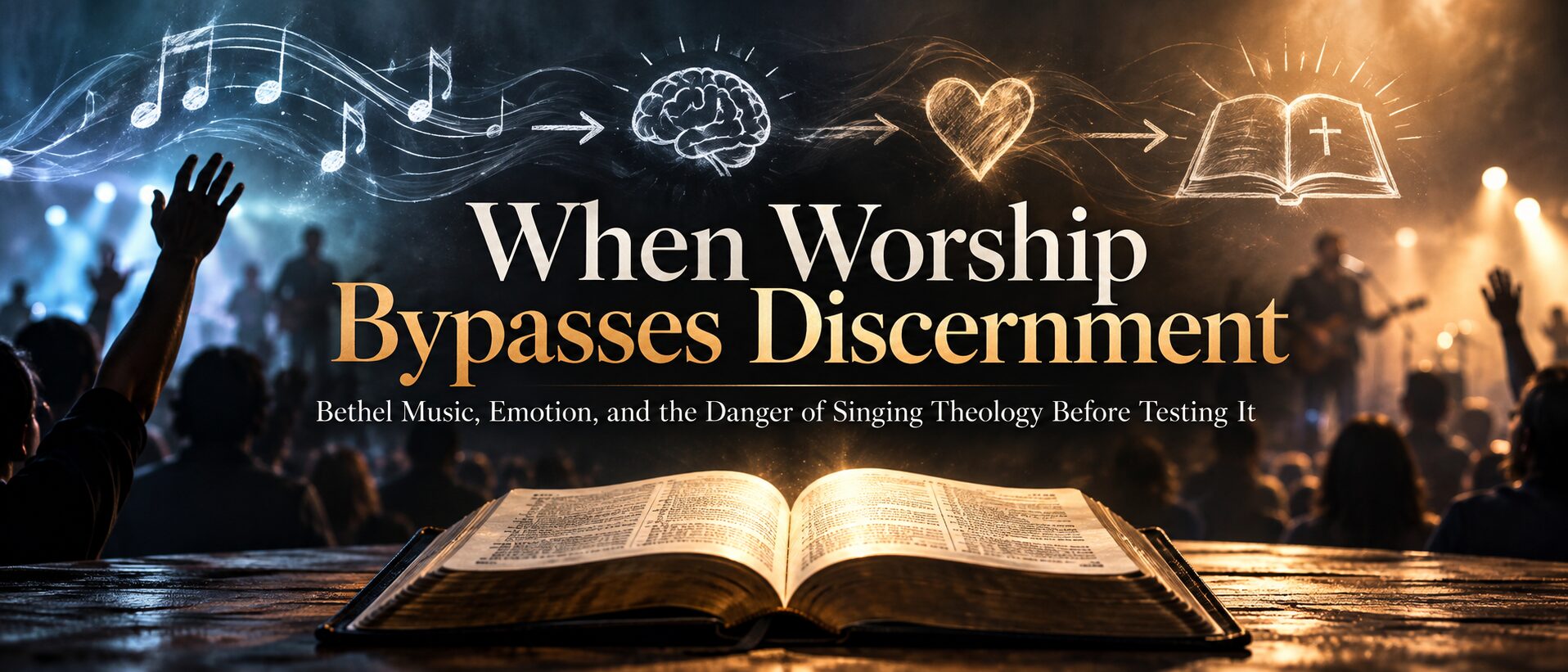
The image attached to this article presents the concern simply:
Music → Mind → Emotions → Teaching
That is not a small observation. Music does not merely decorate theology. It often delivers theology.
Christians remember what they sing. Many believers can recall worship lyrics more easily than sermon outlines. Songs become portable doctrine. They follow people into cars, kitchens, hospital rooms, funerals, prayer closets, and sleepless nights. This is why worship leaders are not merely musicians. They are theological gatekeepers with melodies in their hands.
Colossians 3:16 tells believers to let the message about Christ fill their lives and to teach and counsel one another through psalms, hymns, and spiritual songs. That means songs can teach. They can instruct. They can shape doctrine.
But that also means songs can mis-teach.
If a song places emotional experience over biblical truth, it can disciple people into confusion. If a song constantly centers personal breakthrough, supernatural atmosphere, or human authority while neglecting repentance, the cross, holiness, judgment, and the sufficiency of Scripture, it can slowly tilt a congregation’s theology.
Not always through a direct heresy shouted from the platform.
Sometimes through a repeated emphasis whispered by melody.
The Bethel Music Concern
Bethel Music grew out of Bethel Church in Redding, California. Bethel’s own website describes Bethel Music as beginning as a local church music ministry that became a global outreach of songwriters, artists, and musicians, releasing worship albums intended to inspire and equip the global Church. Bethel’s worship page describes worship as more than a song and as the heartfelt response given to God.
That matters because Bethel Music is not detached from Bethel Church. It is not merely a neutral worship label floating in the air. It comes from a ministry culture with distinct teachings, emphases, leaders, conferences, schools, and theological commitments.
Bethel’s official belief page presents orthodox Christian language on many points, including belief in Jesus, worship, the return of Christ, and spiritual gifts. It also describes the “ever-increasing government of God” and links readers to its “Rediscover Bethel” series addressing questions about theology and practices. Bethel also states that Bethel Music exists to lead people’s hearts into experiences with God’s presence that fuel revival.
Critics, however, argue that Bethel’s broader teaching culture includes controversial emphases commonly associated with the New Apostolic Reformation, often abbreviated NAR. Holly Pivec, a researcher and critic of the movement, argues that Bethel Redding and Bill Johnson fit within NAR categories because of teachings related to present-day apostles, prophets, and church governance. A Modern Reformation interview with Pivec and R. Douglas Geivett defines the NAR as a global movement led by so-called apostles and prophets who, according to NAR beliefs, occupy the highest governing offices in the church.
The Gospel Coalition has also published critiques of the Bethel movement, identifying concerns about healing theology, supernatural practices, and the way Bethel’s influence spreads through worship, conferences, and teaching resources.
So the controversy is not simply, “Do people like Bethel songs?”
The controversy is, “What theological ecosystem do these songs come from, and what are they helping normalize?”
The Widely Attributed Bill Johnson Quote
A quote widely attributed to Bethel leader Bill Johnson says:
“Music bypasses all of the intellectual barriers. And when the anointing of God is on a song, people will begin to believe things they wouldn’t believe through teaching.”
Critics often cite this statement as a warning sign. Servants of Grace published the quote in an article criticizing the influence of Bethel Music. Another article discussing worship discernment notes that the quote has circulated from a now-private WorshipU Facebook context, while acknowledging the original is not publicly accessible.
If the quote is accurate, the concern is serious.
On one level, it is true that music reaches places ordinary teaching may not reach. Scripture itself assumes that singing shapes the heart and mind. Worship can soften resistance, humble pride, and awaken faith.
But if that concept becomes, “Music can get people to believe what they would reject through teaching,” then the alarm bells should ring.
Because biblical faith is not created by bypassing discernment.
Romans 12:2 calls believers to be transformed by the renewing of their minds. Acts 17 commends the Bereans because they searched the Scriptures daily to see if Paul and Silas were teaching the truth. 1 John 4:1 commands believers not to believe everyone who claims to speak by the Spirit, but to test the spirits to see whether they come from God.
Christian worship should not bypass the mind.
It should renew it.
Emotion Is a Gift, but It Is a Terrible Steering Wheel
Christians sometimes overcorrect against emotional worship. That is a mistake.
The Bible is full of emotion. David danced. Jeremiah wept. Hannah poured out her soul. The Psalms cry, shout, mourn, rejoice, plead, confess, and praise. Jesus Himself wept at the tomb of Lazarus and agonized in Gethsemane.
Emotion is not unspiritual.
But emotion must be governed by truth.
A worship service can be emotionally powerful and spiritually shallow. A song can make people cry without making them holy. A chorus can create goosebumps without creating repentance. A room can feel electric while the doctrine being absorbed is thin, man-centered, or untested.
The Holy Spirit does not need manipulation.
He does not need fog machines, crescendos, repetition, or lighting cues to do His work. Those things may be used artistically, but they are not power. The power of worship is not atmosphere. The power of worship is truth carried by the Spirit to hearts submitted to Christ.
When emotion becomes the engine of belief, discernment gets dragged behind the cart.
And that is dangerous.
The New Apostolic Reformation Question
The New Apostolic Reformation is controversial partly because not everyone agrees on how to define it or who belongs to it. Some leaders reject the label. Some critics use the term broadly. Some churches may share certain emphases without formally identifying with the movement.
So Christians should be careful, fair, and precise.
Still, the main concern often associated with NAR teaching is not hard to understand: it elevates present-day apostles and prophets in ways many Christians believe challenge the sufficiency and final authority of Scripture. Critics describe the movement as emphasizing governing apostles and prophets, fresh revelations, supernatural activation, dominion over culture, and extraordinary signs and wonders as central to the Church’s mission.
That concern matters when connected to worship.
If music becomes the emotional front door into a theological system, then Christians must ask whether the songs are functioning as neutral worship or as soft discipleship into that system.
A song may not explicitly teach “modern apostles govern the Church.”
But if the worship culture constantly emphasizes atmosphere, impartation, prophetic declaration, supernatural activation, and experience over careful biblical exposition, then the congregation may be shaped in that direction without ever hearing the formal doctrine explained.
The melody becomes the hallway.
The theology waits in the rooms.
The Bible’s Standard for Worship
Jesus says in John 4:24 that those who worship God must worship in spirit and in truth.
That is the balance.
Spirit without truth becomes wildfire.
Truth without spirit becomes cold stone.
Biblical worship is not dead intellectualism. It is also not emotional intoxication. It is the whole person responding to the true God according to the truth He has revealed.
Worship must be tested by Scripture because Scripture is God-breathed and equips God’s people for every good work. The NLT wording of 2 Timothy 3:16-17 makes clear that all Scripture is inspired by God and useful for teaching, correction, and training in righteousness.
That means the Bible does not sit under worship.
Worship sits under the Bible.
No song, artist, ministry, worship leader, pastor, apostle, prophet, dream, vision, impression, atmosphere, or revival claim has authority over Scripture.
The Word is the measure.
Why This Matters for Churches
Many pastors and worship leaders face a practical question: Should churches sing Bethel Music?
Some answer yes, arguing that many Bethel songs are lyrically biblical and can be used without endorsing every teaching from Bethel Church.
Others answer no, arguing that platforming the songs lends credibility to a ministry ecosystem they believe promotes serious theological error. Critics also argue that royalties and visibility strengthen Bethel’s wider influence. Servants of Grace, for example, has argued that royalties to Bethel Church and Bethel Music matter because they fund and spread Bethel’s broader teaching influence.
This is not a question every church will answer identically.
But no church should answer it lazily.
At minimum, worship leaders should ask:
Does this song clearly teach biblical truth?
Does it center Christ or human experience?
Does it fit the full counsel of Scripture?
Does it require explanation to avoid misunderstanding?
Does using it create confusion about the ministry it comes from?
Are we discipling people to test songs, or merely consume them?
Are we choosing songs because they are true, or because they are popular?
A church’s song list is not a playlist.
It is a catechism with chords.
A Song Can Be True While the Source Is Troubling
One of the harder issues is that a song may contain true lines even if the movement behind it is questionable.
God can use imperfect people. Every hymn writer, preacher, and worship leader is a sinner. If we demanded flawless sources, no one would sing anything.
But there is a difference between imperfect servants and persistent theological concern.
Wisdom asks not merely, “Can this song be interpreted biblically?”
Wisdom also asks, “What does this song normalize? What ministry does this platform? What path does this open? What questions will spiritually immature believers not know to ask?”
Paul teaches in 1 Thessalonians 5:21 to test everything and hold on to what is good. That command requires both discernment and restraint. Testing everything does not mean rejecting everything. Holding on to what is good does not mean ignoring what is dangerous.
The Church needs maturity, not musical tribalism.
The Danger of Singing Before Thinking
The concern raised by your image is not that music reaches emotions. It should.
The concern is that emotions may reach conclusions before Scripture gets a hearing.
That is the danger.
A person may sing about “more” without asking more of what.
A person may sing about “fire” without testing whether the fire is biblical holiness or emotional intensity.
A person may sing about “breakthrough” without asking whether Scripture promises that specific kind of breakthrough.
A person may sing about “declaring” things without learning the difference between prayerful faith and presumptuous speech.
A person may sing about “heaven invading earth” without understanding the already-and-not-yet Kingdom of God.
Music can make vague theology feel profound.
That is why worship must be doctrinally clear.
Fog belongs on the floor, not in the doctrine.
What About the Good Fruit?
Many will say, “But I encountered God through these songs.”
That should not be dismissed coldly.
God is gracious. He often meets people through imperfect vessels. A song from a questionable source may still contain enough truth for God to use it in someone’s life. Many people have sincerely worshiped Christ while singing songs from ministries they later came to question.
The question is not whether God can work through imperfect music.
He can.
The question is whether the Church should knowingly platform ministries if their broader teaching may lead people into error.
God used Balaam’s donkey, but that did not make Balaam a trustworthy prophet.
Fruit must be tested by Scripture, not only by feelings, numbers, tears, or testimonies.
Jesus warns in Matthew 7 that not everyone who performs mighty works in His name truly belongs to Him. That warning should shake every ministry that measures faithfulness mainly by spiritual intensity or visible power.
The final test is not, “Did it feel anointed?”
The final test is, “Was it faithful to Christ and His Word?”
A Biblical Way Forward
Churches do not need fear-based worship policies. They need Scripture-based discernment.
First, teach the congregation that worship songs are theology.
Second, train worship leaders to read lyrics like elders, not entertainers.
Third, evaluate songs before introducing them publicly.
Fourth, be transparent when a song comes from a ministry with known controversy.
Fifth, prioritize songs that clearly proclaim the Gospel, the holiness of God, the cross of Christ, repentance, grace, resurrection, the return of Jesus, and the authority of Scripture.
Sixth, do not let popularity drive worship.
Seventh, remember that emotional intensity is not the same as spiritual maturity.
The Church does not need songs that bypass discernment.
The Church needs songs that awaken discernment.
Conclusion: Worship Must Never Outsing the Word
Bethel Music has become one of the most influential worship movements in the modern Church. That influence deserves careful examination, not reactionary fear and not blind acceptance.
Music is powerful. Worship is formative. Songs teach. Emotions matter. The mind matters. Doctrine matters. The source matters. Scripture matters most.
If a song leads people to love Christ more deeply, confess sin more honestly, trust Scripture more fully, and worship God in spirit and truth, then it is doing holy work.
But if music becomes a means of softening people toward doctrines they would reject if taught plainly from a pulpit, then it becomes dangerous.
The Church must never be discipled by melody alone.
We are not called to shut off our hearts.
We are called to love God with all our heart, soul, mind, and strength.
That includes the mind.
So sing.
Sing loudly.
Sing joyfully.
Sing with tears.
Sing with raised hands.
Sing in suffering.
Sing in victory.
Sing in the night.
But test what you sing.
Because worship is not harmless background noise.
It is formation.
And if the song carries theology, then the Church must make sure the theology is true.