October 2, 2026 by: Rev. Mac
In 1965, America still had prayer in its public memory, churches at the center of many communities, families gathered around dinner tables, and a cultural vocabulary still shaped by Scripture, even when people did not live by it.
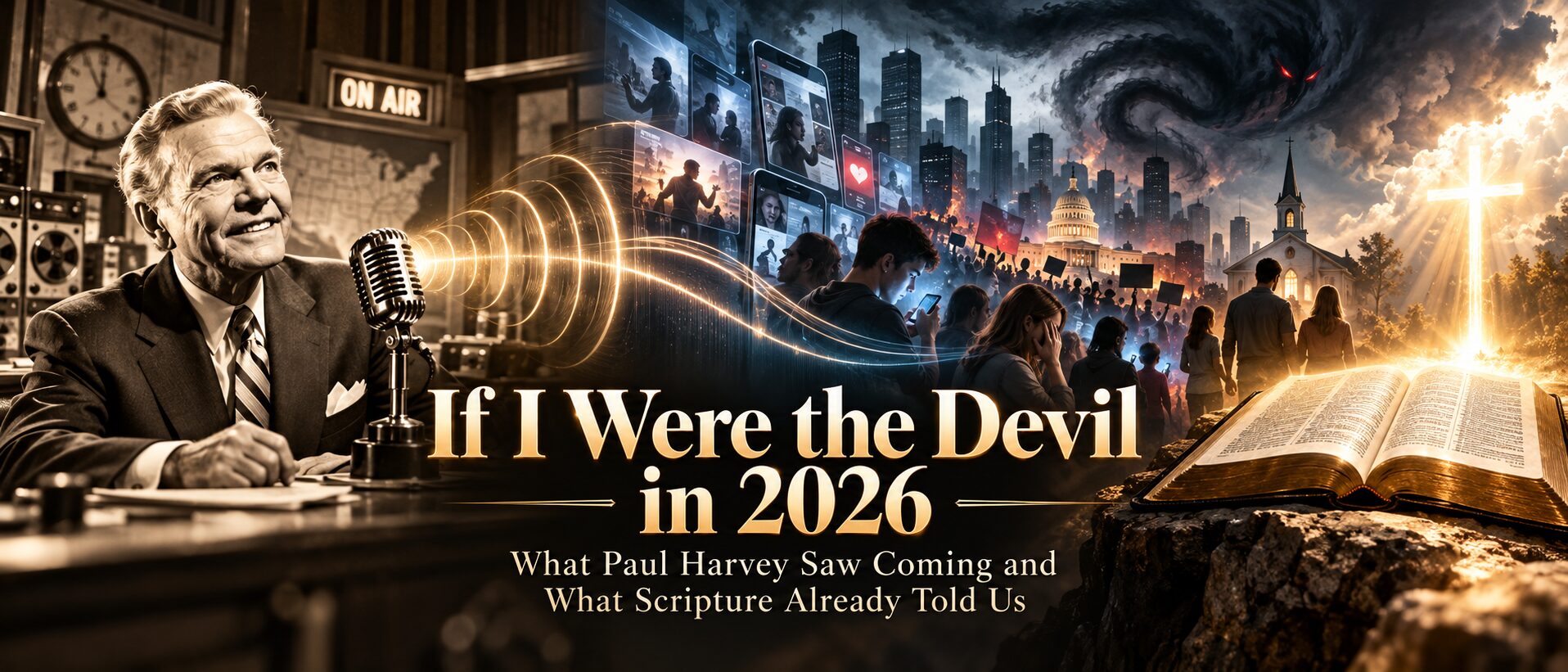
Then Paul Harvey, one of America’s most recognizable radio voices, delivered a short, chilling commentary often remembered by its opening idea: “If I were the devil…”
The piece was not Scripture. It was not prophecy in the biblical sense. It was not a new revelation from God. It was social criticism sharpened into a spiritual warning.
But nearly six decades later, in 2026, many listeners hear it and feel something cold move through the room.
Because what Harvey described sounds painfully familiar.
Families at war with themselves.
Churches divided.
Nations consumed by internal conflict.
Media feeding outrage.
Schools educating minds while neglecting character.
The normalization of immorality.
God pushed out of public life.
Religion weakened from within.
Entertainment growing darker.
Addiction multiplying.
Truth treated as flexible.
Good called bad, and bad called good.
It sounds less like an old radio broadcast and more like a mirror.
That does not mean Paul Harvey was a prophet.
It means Scripture has always been right about the human heart, the schemes of the enemy, and the spiritual consequences of a culture that forgets God.
Who Was Paul Harvey?
Paul Harvey was not a fringe voice. He was one of the most familiar broadcasters in American life. ABC News described him as a radio legend whose career spanned more than 70 years, with programs such as “News & Comment” and “The Rest of the Story” making him a household voice across the country. His broadcasts were carried by more than 1,300 commercial radio stations and hundreds of Armed Forces Radio Service stations, and he received the Presidential Medal of Freedom in 2005. (ABC News)
When President George W. Bush honored Harvey with the Medal of Freedom, he said millions of Americans began their mornings with Paul Harvey and noted that Harvey wrote his own scripts and ad copy for an audience listening on more than 1,200 radio stations and the American Forces Network. (George W. Bush White House Archives)
That matters because Harvey’s “If I Were the Devil” was not whispered from a basement. It came from one of the most trusted microphones in America.
The commentary has circulated in multiple forms. Some sources state that Harvey wrote the piece in 1964 and retold it over the years; others identify a 1965 radio version. A fact-checking summary from Truth or Fiction notes that several versions of the commentary exist and that a Fox Nation article had linked a recording described as airing on ABC Radio on April 3, 1965. (Commonplace Fun Facts)
So the responsible way to handle it is simple: the piece is genuinely associated with Paul Harvey, but the exact wording of online versions should be handled carefully.
For readers who would like to hear the broadcast, you can listen to a recording identified as the April 3, 1965, ABC Radio broadcast of Paul Harvey’s “If I Were the Devil” here. Because multiple versions of the commentary circulate, readers should verify the recording’s date and provenance before treating any online audio as the definitive original.
That is already a lesson for 2026.
Even when sharing something spiritually meaningful, Christians must care about truth.
Not Prophecy, but Discernment
There is a temptation to call Harvey’s words “prophetic.”
In one sense, people use that word casually to mean “ahead of its time.” But biblically, prophecy is not just cultural prediction. Prophecy is revelation from God, and Scripture warns us to test every spirit and every claim.
1 John 4:1 tells believers not to believe everyone who claims to speak by the Spirit, but to test the spirits to see whether they come from God. 1 Thessalonians 5:21 says to test everything and hold on to what is good.
So let us be clear: Paul Harvey’s broadcast is not equal to Scripture.
It should be tested by Scripture.
And when it is tested, much of its warning fits what the Bible already teaches.
Scripture says the devil is real. Jesus calls him the father of lies in John 8:44. 1 Peter 5:8 warns believers to stay alert because the devil prowls like a roaring lion, looking for someone to devour. Ephesians 6:12 says our struggle is not against flesh-and-blood enemies, but against spiritual forces of evil.
That means cultural decline is never merely cultural.
There is always a spiritual dimension.
The Strategy of the Enemy Has Not Changed
In Genesis 3, the serpent did not begin by demanding open Satan worship. He began by questioning God’s Word.
“Did God really say…?”
That is still the strategy.
The devil does not need a society to announce itself as evil overnight. He only needs to make obedience look oppressive, sin look liberating, truth look hateful, holiness look outdated, and God look unnecessary.
Harvey’s commentary understood this. His imagined devil did not begin with chaos in the streets. He began with whispers.
That is biblical.
The enemy often works through suggestion before destruction. He plants doubt before rebellion. He reframes sin before celebrating it. He offers self-rule before chains appear.
James 1:14-15 teaches that temptation begins when our own desires lure us away and trap us; desire gives birth to sinful actions, and sin gives birth to death. Sin rarely introduces itself honestly. It dresses for the occasion.
In 2026, the serpent still whispers.
Only now the whisper has better technology.
Families at War With Themselves
One of the most haunting themes in Harvey’s warning is the breakdown of families.
In 2026, many families are exhausted, fragmented, distracted, and spiritually thin. Parents and children may live under the same roof but inhabit entirely different worlds through screens. Marriage is often treated as temporary. Children are catechized by algorithms before parents realize a sermon is being preached. Conflict enters the home through politics, entertainment, sexuality, identity, money, and fear.
The Bible has always presented the family as spiritually significant. Deuteronomy 6 calls parents to teach God’s commands diligently to their children. Ephesians 6 tells fathers not to provoke their children to anger but to bring them up with discipline and instruction that comes from the Lord.
The enemy does not attack the home because it is unimportant.
He attacks it because it is foundational.
A broken home can still be redeemed. A divorced parent can still raise godly children. A wounded family can still be healed by Christ. But we should not pretend the family is spiritually neutral ground.
If the devil wanted to weaken a nation, he would not need to begin in Congress.
He could begin at the dinner table.
Churches at War With Themselves
Harvey also warned of churches at war with themselves.
That wound feels fresh.
Many churches today are not being destroyed from the outside. They are being hollowed from within by compromise, celebrity culture, scandal, political idolatry, prayerlessness, biblical illiteracy, and division.
Jesus’ letters to the churches in Revelation 2 and 3 show that churches can be busy but loveless, doctrinally compromised, morally tolerant, spiritually dead, or lukewarm. The risen Christ does not flatter them. He calls them to repent.
That matters.
The Church should not hear “If I Were the Devil” and only point at the world.
We should first examine ourselves.
If the devil wanted to weaken America, he would subvert churches first. Not necessarily by closing their doors, but by emptying them of power. He would keep the music, the branding, the buildings, and the livestreams, but remove repentance, holiness, prayer, biblical preaching, and the fear of the Lord.
A church can have lights and still lack fire.
It can have crowds and still lack Christ at the center.
Media Fanning the Flames
One of the most striking parts of Harvey’s warning is the idea of media fanning flames for higher ratings.
In 2026, outrage is not merely a reaction. It is an industry.
News, entertainment, social media, commentary, influencers, and algorithmic platforms often thrive by keeping people angry, afraid, divided, and addicted to the next emotional hit. The technology has changed, but the temptation is ancient: feed the flesh, flatter the tribe, demonize the neighbor, and keep the soul too distracted to pray.
Proverbs 18:21 teaches that the tongue can bring death or life. James 3 warns that the tongue, though small, can set an entire life on fire.
What happens when millions of tongues become a digital wildfire?
Christians must learn to ask: Is this informing me, or inflaming me? Is this leading me to truth, or training me in contempt? Is this making me more prayerful, or more addicted to outrage?
The devil does not have to make people deny God if he can keep them distracted from Him.
Educated Minds, Undisciplined Hearts
Harvey warned of refining intellect while neglecting emotions and discipline.
That line lands like a bell in 2026.
We live in an age of unprecedented information and deep confusion. People can access libraries from a phone but struggle to control anger, lust, envy, anxiety, or despair. We have more data than previous generations could imagine, yet wisdom seems scarce.
Scripture never treats knowledge and character as enemies. God wants minds renewed and hearts transformed.
Romans 12:2 tells believers not to copy the behavior and customs of the world, but to let God transform them into new people by changing the way they think. Proverbs repeatedly connects wisdom with discipline, humility, instruction, and the fear of the Lord.
Education without moral formation can produce clever rebels.
Technology without wisdom can accelerate destruction.
Knowledge without God can become a tower of Babel with better internet.
Calling Evil Good and Good Evil
Perhaps the most biblical-sounding theme in Harvey’s warning is moral inversion.
Isaiah 5:20 warns against calling evil good and good evil, turning darkness into light and light into darkness. That verse reads like a headline over much of modern culture.
In 2026, many Christians feel the pressure to rename sin as compassion and holiness as hatred. Biblical convictions about life, sexuality, marriage, truth, justice, and human identity are often treated as backward or dangerous. Meanwhile, self-expression is frequently elevated as the highest good.
But Christianity is not built on self-expression.
It is built on surrender to Christ.
Jesus does not invite people to discover their truth. He says He is the truth.
That claim remains offensive in every generation.
God Removed From Public Life
Harvey spoke of God being pushed out of public spaces.
Christians must be careful here. America was never the Kingdom of God. Public references to God do not automatically mean a nation is righteous. A courthouse with a Bible verse carved in stone can still render injustice. A school that says a prayer can still fail to disciple hearts. A Congress that invokes God can still ignore Him.
Still, there is a real difference between a society that publicly acknowledges dependence on God and one that treats God as an embarrassment.
Psalm 33:12 says blessed is the nation whose God is the Lord. That does not mean political slogans can save a people. It means public life matters because worship matters.
When God is removed from public imagination, something else always takes His place.
The throne never stays empty.
The Danger of Making Government Our Father
One of the most piercing lines often associated with the older versions of Harvey’s commentary is the warning that people might be taught to pray, “Our Father, which art in Washington.”
That line is not merely political. It is theological.
Government has a rightful role. Romans 13 teaches that civil authority exists to restrain evil and promote order. Christians should pray for leaders, seek justice, and work for the good of their communities.
But government is not God.
When people expect the state to provide meaning, morality, identity, salvation, security, and ultimate hope, they have crossed from citizenship into idolatry.
Psalm 146 warns not to put confidence in powerful people because there is no help for us there. Human rulers die. Their plans die with them. But the Lord reigns forever.
The Christian can be a good citizen without making politics a savior.
Addiction, Numbness, and the Tranquilized Soul
Harvey warned of narcotics, alcohol, pills, and the dulling of a population.
The Bible speaks often about sobriety, not merely as avoidance of drunkenness, but as a spiritual posture. 1 Peter 5:8 says to stay alert. Ephesians 5:18 warns against being drunk with wine and calls believers to be filled with the Holy Spirit.
The issue is not only substances.
A soul can be intoxicated by entertainment, pornography, outrage, consumerism, comfort, approval, or endless scrolling. The enemy wants people numb enough not to notice their chains.
In 2026, many are not openly hostile toward God.
They are simply sedated.
Too entertained to seek Him.
Too anxious to hear Him.
Too busy to obey Him.
Too distracted to repent.
That may be one of the devil’s quietest victories.
What Harvey Saw, Scripture Already Said
Paul Harvey’s commentary feels prophetic because Scripture is true.
He noticed patterns the Bible had already revealed.
The devil deceives.
Sin destroys.
Families matter.
Churches can drift.
Media can inflame.
Knowledge can lack wisdom.
Government can become an idol.
Immorality can be normalized.
God can be pushed aside.
People can mistake freedom for rebellion.
Harvey’s broadcast did not create these truths.
It echoed them.
That is why Christians should appreciate the warning without treating it as Scripture. A wise cultural commentator can point to smoke. The Bible tells us where the fire began.
The Christian Response in 2026
The right response is not nostalgia.
It is repentance.
We do not need merely to return to 1965. That year had its own sins, blind spots, injustices, and spiritual failures. The past was not paradise.
We need to return to Christ.
Not to a decade.
Not to a political party.
Not to a cultural aesthetic.
Not to a romanticized America.
To Christ.
2 Chronicles 7:14 calls God’s people to humble themselves, pray, seek His face, and turn from wicked ways. The promise of healing begins not with blaming the world, but with God’s people repenting.
If the world is dark, the Church must shine.
If the culture is confused, the Church must teach truth.
If families are breaking, Christian homes must recover prayer and discipleship.
If media fans flames, believers must become peacemakers without becoming cowards.
If sin is normalized, Christians must be holy without becoming hateful.
If the devil whispers, the Church must answer with the Word of God.
Jesus did exactly that in the wilderness. When tempted by Satan, He answered with Scripture.
So must we.
Conclusion: The Rest of the Story Is Still Being Written
Paul Harvey was famous for telling “the rest of the story.”
In 2026, the rest of this story is not yet finished.
Yes, much of what he warned about appears painfully visible. The moral drift is real. The confusion is real. The division is real. The attack on truth is real. The spiritual battle is real.
But so is Christ.
Jesus is not pacing heaven in panic.
The Holy Spirit has not retired.
The Word of God has not lost power.
The Gospel has not expired.
The Church has not been abandoned.
The devil is not sovereign.
Colossians 2 teaches that Christ disarmed spiritual rulers and authorities through the cross. John 1 says the light shines in the darkness, and the darkness can never extinguish it. Revelation declares that the kingdoms of this world will become the Kingdom of our Lord and of His Christ.
So listen to the warning.
But do not worship the fear.
Let Paul Harvey’s old broadcast remind us of what Scripture has always said: deception is real, the devil is cunning, sin destroys, and a nation that forgets God will reap sorrow.
But let Scripture have the final word.
Not the devil.
Not decline.
Not despair.
Jesus Christ is Lord.
And that is the rest of the story.