
October 8, 2026 by: Rev. Mac
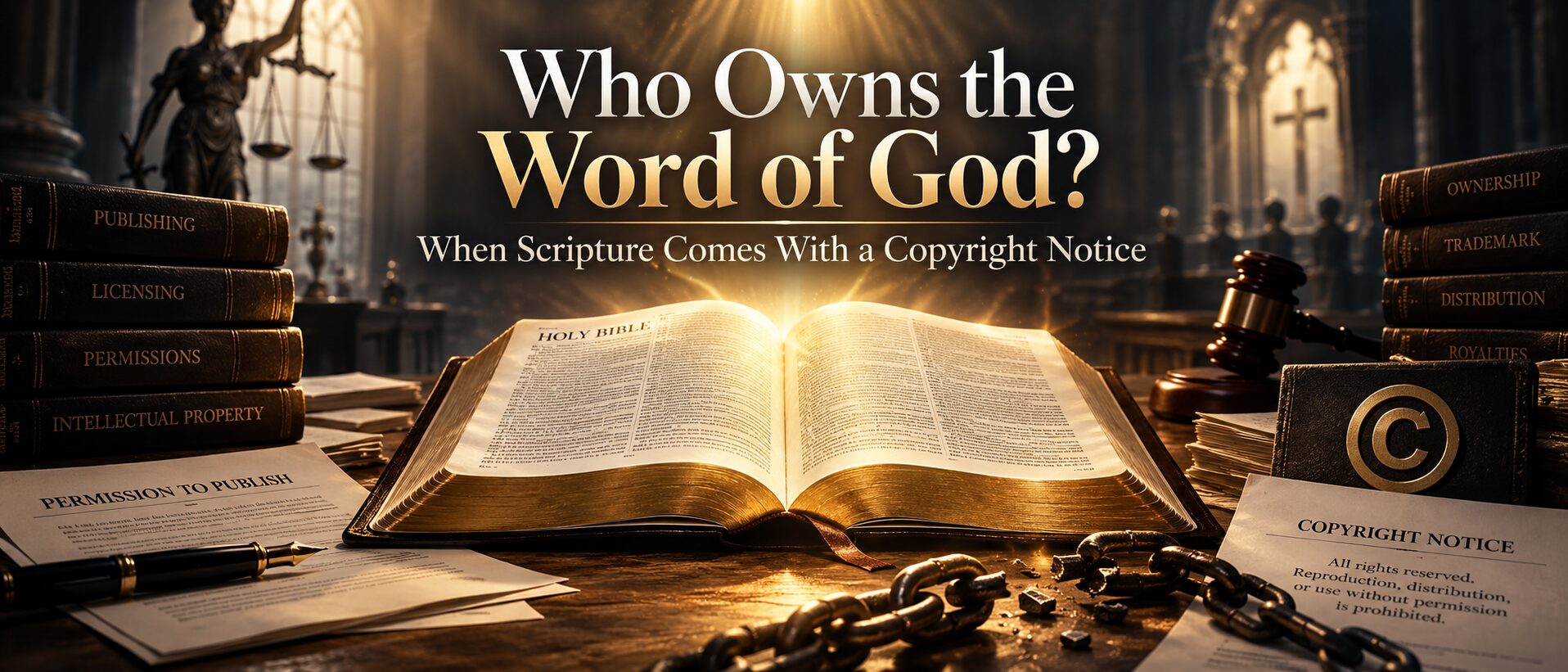
The uncomfortable question facing Christian publishers: Can we protect the work of Bible translation without placing unnecessary barriers around the very Word we are commanded to share?
Imagine receiving a calling to spread the Word of God.
You want to create a children’s Bible. Perhaps a graphic novel bringing Genesis to life for a new generation. Maybe a Bible study for struggling families, a recovery ministry resource, a Christian film, or an online library making Scripture available to people who otherwise might never open a Bible.
Your motivation is not greed. It is ministry.
You want people to encounter Jesus Christ.
You choose a trusted, modern Bible translation because you believe its language will help people understand Scripture. You begin planning, writing, illustrating, and preparing your project.
Then you discover something unexpected.
You may need permission from a publisher to reproduce the words of the Bible.
Not because Scripture itself belongs to that publisher, but because the particular English translation is copyrighted.
There is something deeply ironic about that moment.
The message tells us salvation is a gift. The Word calls us to share the Gospel. Jesus sends His followers into the world to make disciples. Yet the modern English words carrying that message may come with copyright notices, reproduction limits, licensing agreements, and restrictions on how they can be published.
And suddenly, a difficult question emerges:
If God’s Word was given to humanity, why does humanity need permission to reproduce certain versions of it?
The answer is more complicated than simply accusing Christian publishers of greed. Translating Scripture involves extraordinary scholarship, resources, time, and responsibility.
But recognizing that work does not mean Christians should stop questioning how its ownership is exercised.
Because there is a fundamental difference between protecting someone’s labor and restricting access to a message that Christians believe belongs to God.
The Discovery Many Christians Never Make
Most believers rarely think about Bible copyright.
We purchase Bibles, download Bible applications, highlight verses, share Scripture on social media, and listen to sermons containing quotations from different translations.
For everyday reading and ordinary quotation, copyright seldom creates an obstacle.
But when someone attempts to publish a substantial Scripture-based work, the situation changes.
The New Living Translation (NLT), New King James Version (NKJV), New International Version (NIV), and English Standard Version (ESV) are all copyrighted modern Bible translations.
Under Tyndale’s published permissions policy, the NLT may generally be quoted in print or eBooks without an individual written permission request, up to 500 verses, provided those quotations do not exceed 25 percent of the finished work and do not reproduce an entire biblical book.
The NKJV, published by Thomas Nelson, has a broadly similar quotation allowance, with additional conditions for commentaries and biblical reference works. Its copyright terms identify Thomas Nelson as the copyright holder.
Crossway’s ESV permissions policy likewise allows substantial quotation under specified conditions while retaining rights over the translation.
These publishers are not generally requiring someone to request written permission before quoting a few Bible verses.
That would be an exaggeration.
But reproducing entire biblical books, creating certain commercial products, building extensive Scripture resources, or producing adaptations may require licenses or additional authorization.
Consider the person who wants to transform the entire Book of Genesis into an illustrated publication using the exact wording of the NLT or NKJV.
That person is not simply quoting a few verses in a sermon.
They are creating a substantial new publication built upon a copyrighted translation. That raises permission questions even if the project’s purpose is evangelism.
And this is where the tension becomes real.
A Christian may be free to share the Gospel’s message, but not necessarily free to reproduce every modern translation of that message in the form they envision.
Did Someone Actually Copyright God’s Words?
This is where precision matters.
No modern publisher created the Book of Genesis. No corporation authored the Sermon on the Mount. No licensing department inspired the apostle Paul to write to the churches.
The Scriptures existed long before modern copyright law.
What copyright protects in the United States is the human-authored expression of a modern translation, not the divine revelation itself or the ancient biblical texts as such.
According to the United States Copyright Office, translations are a form of derivative work. Copyright protection in new material does not give its creator ownership of preexisting public-domain material.
That distinction is legally significant.
The translators have made thousands of decisions involving vocabulary, grammar, sentence structure, literary style, textual interpretation, and readability.
Their work can be protected.
But the message did not originate with them.
And that is where the legal answer and the theological question begin to separate.
Copyright may establish who controls the translation. It cannot establish who owns the truth being translated.
Christians believe that authority belongs to God alone.
Second Timothy 3:16, in the NLT, teaches that all Scripture is inspired by God and is useful for teaching, correction, and training in righteousness.
That means Scripture’s authority does not come from the publisher whose name appears on the copyright page.
It comes from the God who inspired it.
A publisher may own a particular English rendering.
It does not own the Gospel.
Jesus Said to Give Freely
One of the most challenging passages for this conversation is Matthew 10:8.
Jesus tells His disciples, in the NLT:
“Give as freely as you have received!”
Those words occur as Jesus sends His disciples out to minister, heal, and proclaim the Kingdom. They are not a direct legal command concerning modern Bible translation copyrights.
We should not pretend otherwise.
But they do reveal something important about the heart of Christian ministry.
God’s gifts are not meant to become instruments of exploitation.
The disciples were not supposed to treat God’s power as merchandise.
The Gospel was not something they had invented, purchased, or earned. It had been entrusted to them.
And what had been entrusted to them was meant to be shared.
That principle should matter deeply to every Christian organization entrusted with the work of making Scripture understandable.
The question is not whether Bible publishers have legal rights.
They do.
The question is how those rights should be exercised by organizations claiming to serve the mission of Christ.
Should the controlling consideration always be ownership?
Or should it be faithful stewardship?
What Would the Apostle Paul Say?
The apostle Paul offers a particularly challenging perspective on the relationship between ministry and money.
In 2 Corinthians 2:17, Paul distinguishes his ministry from those who preach for personal profit.
His concern was not that anyone involved in Christian ministry received financial support. Scripture clearly permits that.
His concern was sincerity, motive, and the integrity of God’s message.
In 1 Corinthians 9:14-18, Paul explains that those who preach the Gospel have a legitimate right to material support.
That is important.
Christian translators deserve compensation. Editors deserve compensation. Scholars, proofreaders, designers, typesetters, and publishers all contribute real labor.
Nothing in Scripture requires every Christian professional to work without pay.
But Paul also demonstrates a willingness to surrender his own financial rights for the sake of removing obstacles to the Gospel.
He understood something that modern Christian organizations should continually examine:
Having a right does not always mean exercising that right is the wisest or most Christ-honoring choice.
A ministry may legally charge a fee.
It may also decide that waiving the fee will serve the Kingdom more faithfully.
A publisher may legally restrict a particular use.
It may also recognize that the proposed use could introduce thousands of people to Scripture.
The Christian question is not merely, “Are we entitled to control this?”
It is, “Does exercising that control advance the mission Jesus entrusted to us?”
The Difference Between Stewardship and Control
There are legitimate reasons to protect a Bible translation.
A publisher may want to prevent inaccurate alterations, misleading attribution, unauthorized editions, or commercial products that misrepresent the text.
Those concerns should not be dismissed.
Imagine someone changing the meaning of a passage while continuing to market it as the NLT. Readers could reasonably believe the altered language represented the work of its translators.
Protecting textual integrity matters.
But there is a difference between preventing misrepresentation and controlling every substantial reproduction.
That difference deserves scrutiny.
If a ministry wants to publish Scripture faithfully, properly credit the translators, and distribute the resulting material for evangelism, should obtaining approval be unnecessarily expensive, slow, or complicated?
If a church wants to create accessible biblical resources for people with disabilities, should legal uncertainty become a significant barrier?
If a nonprofit wants to produce an illustrated Bible resource for children, should the question of licensing outweigh the opportunity to make God’s Word understandable?
Those are not accusations that every publisher is acting improperly.
They are questions Christian organizations should welcome.
Because the Church should never become so accustomed to the business of publishing Scripture that it forgets the purpose of publishing Scripture.
The Bible Is Not a Product Like Every Other Product
Publishing houses operate in a real economy.
Printing costs money. Distribution costs money. Digital infrastructure costs money. Translation committees require funding. Responsible stewardship requires budgets, contracts, and sustainable operations.
But the Bible occupies a unique place.
A Christian publisher is not merely producing another commercial literary work.
It is handling a text that the Church confesses to be the inspired Word of God.
That should create an extraordinary ethical responsibility.
The purpose of Scripture is not simply to be sold.
According to John 20:30-31, John’s Gospel was written so readers would believe Jesus is the Messiah, the Son of God, and have life through faith in Him.
Romans 10:17 teaches that faith comes from hearing the Good News about Christ.
Second Timothy 3:15 describes Scripture as able to give the wisdom that leads to salvation through faith in Jesus Christ.
Those are eternal purposes.
They are not ordinary consumer benefits.
So while the Bible may be printed, packaged, marketed, and sold, its spiritual purpose must never be reduced to a commercial transaction.
The Gospel is not a franchise, and salvation is not intellectual property.
The Word of God Cannot Be Chained
There is another remarkable verse that deserves attention.
In 2 Timothy 2:9, Paul describes his suffering and imprisonment for preaching the Gospel.
Then he declares:
“But the word of God cannot be chained.”
Paul was speaking about imprisonment and the continued power of God’s message, not issuing a statement about copyright law.
Nevertheless, the principle is unmistakably powerful.
Human beings cannot ultimately imprison divine truth.
Governments have tried to silence Scripture. Empires have persecuted its messengers. Churches have experienced opposition, exile, imprisonment, and death.
Yet the Gospel has continued to spread.
No modern copyright agreement can change that eternal reality.
But Christians should still ask whether the systems surrounding modern Scripture publishing make the Word easier or harder to distribute.
A message that cannot ultimately be chained should not be unnecessarily fenced in by those entrusted to spread it.
That is a matter of Christian conscience, not merely commercial policy.
A Different Model Already Exists
One of the most revealing facts in this discussion is that copyrighted Bible translations are not the only option.
The World English Bible is a modern English translation dedicated to the public domain.
Its publishers explicitly permit people to copy, distribute, publish, broadcast, print, and even sell the translation without obtaining traditional copyright permission.
They retain trademark protections to prevent altered editions from being misrepresented as the official World English Bible.
That is a significant distinction.
It demonstrates that a Bible translation can protect its identity while making its text broadly available for reuse.
The existence of a public-domain modern translation does not prove that every publisher must adopt precisely the same model.
But it does challenge the assumption that restrictive copyright is the only responsible way to preserve biblical integrity.
There are alternatives.
And perhaps Christian publishers should spend more time exploring them.
What About the King James Version?
The historic King James Version offers another useful example.
The original 1611 translation is generally treated as public domain in the United States, though special rights concerning the Authorized Version exist in the United Kingdom.
This helps explain why the KJV is widely available for reproduction in American publishing projects.
But there is an important warning here for anyone producing Christian literature.
The New King James Version is not the same as the original King James Version.
Despite their related names, the NKJV is a modern copyrighted translation.
Simply switching from the NLT to the NKJV does not eliminate copyright considerations.
A publisher creating an illustrated book of Genesis, a Christian comic series, a Bible application, or an extensive collection of Scripture readings must still evaluate the applicable rights.
Modern language and unrestricted reproduction are two different issues.
That practical reality can surprise even experienced Christian creators.
A Ministry Should Not Have to Choose Between Excellence and Accessibility
This is perhaps the greatest challenge.
The modern Church has opportunities earlier generations could scarcely imagine.
Christian filmmakers can create biblical stories with extraordinary visual quality. Artists can bring Scripture to life through illustrated narratives. Developers can create immersive Bible applications. Teachers can build interactive discipleship resources. Churches can reach people internationally through digital media.
But many of the clearest contemporary Bible translations remain protected intellectual property.
That creates a real tension for people trying to build ambitious, Scripture-centered projects.
Should they use older public-domain language that younger audiences may struggle to understand?
Should they undertake the enormous task of developing a new translation?
Should they negotiate licenses before beginning production?
Or should Christian publishers find new ways to support high-quality evangelistic projects without unnecessary restrictions?
I believe the better question is not how to eliminate every form of copyright.
It is how to ensure copyright serves the mission rather than allowing the mission to become secondary to copyright.
Christian publishers could expand straightforward licensing for evangelistic projects, make nonprofit permissions easier to obtain, support broad accessibility, publish clearer guidance for artists and digital creators, and consider open licensing for additional resources.
These approaches would still recognize human labor.
They would simply place greater emphasis on the eternal purpose of that labor.
What Does Scripture Actually Require?
Christians should resist the temptation to use Scripture carelessly in this debate.
The Bible does not contain a verse explicitly forbidding copyright protection for future translations.
It does not teach that translators must never receive payment.
It does not declare that every printing, licensing, or publishing agreement is sinful.
But Scripture gives us principles that should govern our decisions.
Matthew 10:8 calls disciples toward generosity with what God has entrusted to them.
First Corinthians 9 recognizes legitimate financial support for Gospel workers while demonstrating a willingness to surrender personal rights for the advancement of ministry.
Second Corinthians 2:17 warns against preaching for personal profit.
First Peter 5:2 calls spiritual leaders to serve willingly and not from greed.
And 2 Timothy 3:16-17 reminds the Church that Scripture is given by God to teach, correct, prepare, and equip His people.
Taken together, these passages do not create a modern copyright statute.
They create a moral standard.
The standard is stewardship, sincerity, generosity, integrity, and faithfulness to Christ.
That standard applies to pastors, ministries, Bible teachers, writers, publishers, translators, and every Christian entrusted with spreading God’s Word.
The Irony We Should Not Ignore
There is something worth reflecting upon when a Christian publication carries both an invitation to salvation and a copyright notice governing reproduction of the biblical text.
Legally, that may be perfectly understandable.
Theologically, it should still make us think.
The message is freely offered.
The particular translation is protected.
The Savior invites all who are weary to come to Him.
The publisher maintains conditions concerning how its rendering of that invitation may be reused.
Those truths can coexist legally, but Christians should not pretend there is no tension between them.
The tension is precisely what makes this conversation necessary.
Because our responsibility is not merely to follow whatever intellectual-property system happens to exist.
Our higher responsibility is to ask whether our practices reflect the heart of the Savior whose Word we are distributing.
Jesus did not come to create a publishing empire.
He came to seek and save the lost.
Conclusion: God’s Word Was Never Ours to Own
Perhaps the deepest problem is not copyright itself.
Perhaps it is the ease with which we have become comfortable treating sacred responsibility in the same language as commercial ownership.
We speak of rights, permissions, licensing, territories, royalties, markets, and reproduction agreements.
Those concepts may have legitimate uses.
But none of them should ever become more important than the mission.
The Word of God was not given merely to be admired on shelves, protected in corporate records, or reproduced only by those with sufficient resources.
It was given to reveal God’s truth, expose sin, proclaim redemption, strengthen believers, and lead people to Jesus Christ.
Human beings may rightfully protect the labor involved in translation.
But we must never forget that the message itself is not ours.
It belongs to God.
And God has commanded His people to share it.
So perhaps it is time for Christian publishers, ministries, and believers to begin asking a different question.
Not merely, “How do we protect our rights?”
But:
“How do we remove every unnecessary obstacle between God’s Word and the people who desperately need to hear it?”
Let translators be compensated fairly.
Let the integrity of Scripture be protected.
Let publishers operate responsibly.
But let the Church also demonstrate extraordinary generosity with the message entrusted to its care.
Because when a broken person opens the Bible, when a child encounters Christ through an illustrated story, when a prisoner discovers redemption, or when someone seeking truth finally reads the Gospel, the most important issue is not which organization holds the copyright.
It is whether that person encounters the living Jesus Christ.
God’s Word was entrusted to us to proclaim, not to possess.
And the mission of the Church must always be greater than the business of publishing it.
Scripture references throughout this article are from the New Living Translation (NLT). Scripture quotations are taken from the Holy Bible, New Living Translation, copyright © 1996, 2004, 2015 by Tyndale House Foundation. Used by permission of Tyndale House Publishers, Inc., Carol Stream, Illinois 60188. All rights reserved.